Showing posts with label Our Lord. Show all posts

Monday, April 21, 2014

An Easter meditation

 from The Liturgical Year by Abbot Dom Guéranger, O.S.B.
He is risen: He is not here! The Corpse, laid by the hands of them that loved their Lord, on the slab that lies in that cave, is risen; and, without removing the stone that closed the entrance, has gone forth, quickened with a life which can never die. No man has helped Him. No prophet has stood over the dead Body, bidding it return to life. It is Jesus Himself, and by His own power, that has risen. He suffered death, not from necessity, but because He so willed; and again, because He willed, He has delivered Himself from its bondage. O Jesus! Thou, that thus mockest death, art the Lord our God! We reverently bend our knees before this empty tomb, which is now forever sacred, because, for a few hours, it was the place of Thy abode. Behold the place where they laid Him! Behold the winding-sheet and bands, which remain to tell the mystery of Thy having once been dead! The angel says to the women: Ye seek Jesus of Nazareth, who was crucified! The recollection makes us weep. Yes, it was but the day before yesterday that His Body was carried hither, mangled, wounded, bleeding. Here, in this cave, from which the angel has now rolled back the stone--in this cave, which His presence fills with a more than mid-day brightness--stood the afflicted Mother.  It echoed with the sobs of them that were at the burial, John and the two disciples, Magdalen and her companions. The sun sank beneath the horizon, and the first day of Jesus' burial began. But the prophet has said: 'In the evening weeping shall have place; and in the morning gladness' (Psalm 29:6). This glorious, happy morning has come, O Jesus! and great indeed is our gladness at seeing that this same sepulchre, whither we followed Thee with aching hearts, is now but the trophy of Thy victory! Thy precious wounds are healed! It was we that caused them; permit us to kiss them. Thou art now living, more glorious than ever, and immortal. And because we are resolved to die to our sins, when Thou wast dying in order to expiate them, Thou willest that we, too, should live eternally with Thee; that Thy victory over death should be ours; that death should be for us, as it were for Thee, a mere passage to immortality, and should one day give back, uninjured and glorified, these bodies which are to be lent for a while to the tomb. Glory, then, and honor and love, be to Thee, O Jesus! who didst deign not only to die, but to rise again for us!

Saturday, April 19, 2014

A Love so Great It Will Be the Admiration of the Ages

(The following is an excerpt from the classic book, The Passion and Death of Jesus Christ, by St. Alphonsus Liguori.)
We read in history of a proof of love so prodigious that it will be the admiration of all ages.
There was once a king, lord of many kingdoms, who had one only son, so beautiful, so holy, so amiable, that he was the delight of his father, who loved him as much as himself. This young prince had a great affection for one of his slaves; so much so that, the slave having committed a crime for which he had been condemned to death, the prince offered himself to die for the slave; the father, being jealous of justice, was satisfied to condemn his beloved son to death, in order that the slave might remain free from the punishment that he deserved: and thus the son died a malefactor's death, and the slave was freed from punishment.
This fact, the like of which has never happened in this world, and never will happen, is related in the Gospels, where we read that the Son of God, the Lord of the universe, seeing that man was condemned to eternal death in punishment of his sins, chose to take upon Himself human flesh, and thus to pay by His death the penalty due to man: He was offered because it was His own will (Is. 53:7).  And his Eternal Father caused him to die upon the cross to save us miserable sinners: He spared not his own Son, but delivered Him up for us all (Rom. 8:32). What dost thou think, O devout soul, of this love of the Son and of the Father?
Thou didst, then, O my beloved Redeemer, choose by Thy death to sacrifice Thyself in order to obtain the pardon of my sins. And what return of gratitude shall I then make to Thee? Thou hast done too much to oblige me to love Thee; I should indeed be most ungrateful to Thee if I did not love Thee with my whole heart. Thou hast given for me Thy divine life; I, miserable sinner that I am, give Thee my own life. Yes, I will at least spend that period of my life that remains to me only in loving Thee, obeying Thee, and pleasing Thee.
O men, men! let us love this our Redeemer, who, being God, has not disdained to take upon Himself our sins, in order to satisfy by His sufferings for the chastisement which we have deserved: Surely He hath borne our infirmities, and carried our sorrows (Is. 53:4)
St. Augustine says that our Lord in creating us formed us by virtue of His power, but in redeeming us He has saved us from death by means of His sufferings: "He created us in his strength; he sought us back in his weakness."
How much do I not owe Thee, O Jesus my Saviour! Oh, if I were to give my blood a thousand times over,--if I were to spend a thousand lives for Thee,--it would yet be nothing. Oh, how could anyone that meditated much on the love which Thou hast shown him in Thy Passion, love anything else but Thee? Through the love with which Thou didst love us on the cross, grant me the grace to love Thee with my whole heart. I love Thee, infinite Goodness; I love Thee above every other good; and I ask nothing more of Thee but Thy holy love.

Meditations for Good Friday

A meditation from The Liturgical Year by Abbot Dom Guéranger, O.S.B.
THE MORNING: The sun has risen upon Jerusalem. But the priests and scribes have not waited all this time without venting their rage upon Jesus. Annas, who was the first to receive the divine Captive, has had Him taken to his son-in-law Caiphas, the high priest. Here He is put through a series of insulting questions, which disdaining to answer, He receives a blow from one of the high priest’s servants. False witnesses had already been prepared: they now come forward, and depose their lies against Him who is the very Truth: but their testimony is contradictory. Then Caiphas, seeing that this plan for convicting Jesus of blasphemy is only serving to expose his accomplices, turns to another. He asks Him a question, which will oblige our Lord to make an answer; and in this answer he, Caiphas, will discover blasphemy, and blasphemy will bring Jesus under the power of the Synagogue. This is the question: ‘I adjure Thee, by the living God, that Thou tell us, if Thou be the Christ the Son of God! [1] Our Saviour, in order to teach us that we should show respect to those who are in authority, breaks the silence He has hitherto observed, and answers: Thou hast said it: I am: and hereafter ye shall see the Son of Man sitting on the right hand of the power of God, and coming in the clouds of heaven.’ [2] Hereupon, the impious pontiff rises, rends his garments, and exclaims: ‘He hath blasphemed! What further need have we of witnesses? Behold! now ye have heard the blasphemy: what think ye?’ The whole place resounds with the cry: ‘He is guilty of death!’ [3]  
The Son of God has come down upon the earth in order to restore man to life; and yet, here we have this creature of death daring to summon his divine Benefactor before a human tribunal, and condemning Him to death! And Jesus is silent, and bears with these presumptuous, these ungrateful, blasphemers! Well may we exclaim, in the words wherewith the Greek Church frequently interrupts to-day’s reading of the Passion: ‘Glory be to thy patience, O Lord!’  
Scarcely have the terrible words, ‘He is guilty of death,’ been uttered, than the servants of the high priest rush upon Jesus. They spit upon Him, and blindfolding Him, they strike Him, saying: ‘Prophesy, who is it that struck Thee?’ [4] Thus does the Synagogue treat the Messias, who, they say, is to be their glory! And yet, these outrages, frightful as they are, are but the beginning of what our Redeemer has to go through.  
But there is something far more trying than all this to the heart of Jesus, and it is happening at this very time. Peter has made his way as far as the court of the high priest’s palace. He is recognized by the bystanders as a Galilean, and one of Jesus’ disciples. The apostle trembles for his life; he denies his Master, and affirms with an oath that he does not even know Him. What a sad example is here of the punishment of presumption! But Jesus has mercy on His apostle. The servants of the high priest lead Him near to the place where Peter is standing; He casts upon him a look of reproach and pardon; Peter immediately goes forth, and weeps bitterly. From this hour forward he can do nothing but lament his sin; and it is only on Easter morning, when Jesus shall appear to him after His Resurrection, that he will admit any consolation to his afflicted heart. Let us make him our model, now that we are spending these hours, with our holy mother the Church, in contemplating the Passion of Jesus. Peter withdraws, because he fears his own weakness; let us remain to the end, for what have we to fear? May our Jesus give us one of those looks, which can change the hardest and worst of hearts!  
Meanwhile, the day-dawn breaks upon the city, and the chief priests make arrangements for taking Jesus before the Roman governor. They themselves have found Him guilty; they have condemned Him as a blasphemer, and according to the Law of Moses a blasphemer must be stoned to death. But they cannot apply the law: Jerusalem is no longer free, or governed by her own laws. The power over life and death may be exercised only by her conquerors, and that in the name of Cæsar. How is it that these priests and scribes can go through all this, and never once remember the prophecy of Jacob, that the Messias would come when the sceptre should be taken away from Juda? [5] They know off by heart, they are the appointed guardians of, those prophecies, which describe the death to which this Messias is to be put; and yet, they are the very ones who bring it about! How is all this? They are blind, and it is jealousy that blinds them.  
The rumour of Jesus’ having been seized during the night, and that He is on the point of being led before the Roman governor, rapidly spreads through the city, and reaches Judas’ ears. This wretched man had a passion for money, but there was nothing to make him desire the death of his divine Master. He knew Jesus’ supernatural power. He perhaps flattered himself that He, who could command nature and the elements, would easily escape from the hands of His enemies. But now when he sees that He does not escape, and that He is to be condemned to death, he runs to the temple, and gives back the thirty pieces of silver to the chief priests. Is it that he is converted, and is about to ask his Master to pardon him? Alas, no! Despair has possession of him, and he puts an end to his existence. The recollection of all the merciful solicitations made to him, yesterday, by Jesus, both during the last Supper, and in the garden, gives him no confidence; it only serves to increase is despair. Surely, he well knew what a merciful Saviour he had to deal with! And yet, he despairs, and this at the very time when the Blood, which washes away the sins of the whole world, is about to be shed! He is lost, because he despaired.  
The chief priests, taking Jesus with them, present themselves at the governor’s palace, demanding audience for a case of importance. Pilate comes forward, and peevishly asks them: ‘What accusation bring ye against this Man?’ They answer: ‘If He were not a malefactor, we would not have delivered Him up to thee.’ It is very evident, from these first words, that Pilate has a contempt for these Jewish priests; it is not less evident that they are determined to gain their cause. ‘Take Him you,’ says Pilate, ‘and judge Him according to your Law.’ The chief priests answer: ‘It is not lawful for us to put any man to death.’ [6]  
Pilate leaves the hall, in order to speak with these men. He returns, and commands Jesus to be brought in. The Son of God and the representative of the pagan world are face to face. Pilate begins by asking Him: ‘Art Thou the King of the Jews?’ To this Jesus thus replies: ‘My kingdom is not of this world. If My kingdom were of this world, My servants would certainly strive that I should not be delivered to the Jews. But now My kingdom is not from hence’. ‘Art Thou a King, then?’ says Pilate. ‘Thou sayest,’ answers Jesus, ‘that I am a King.’ Having, by these last words, confessed His august dignity, our Lord offers a grace to this Roman; He tells him that there is something worthier of man’s ambition than earthly honours. ‘For this,’ says Jesus, ‘was I born, and for this came I into the world; that I should give testimony to the truth. Every one that is of the truth heareth My voice.’ ‘What is truth?’ asks Pilate; but without waiting for the answer, he leaves Jesus, for he is anxious to have done with this case. He returns to the Jews, and says to them: ‘I find no cause in Him.’ [7] Pilate fancies that this Jesus must be a leader of some Jewish sect, whose teachings give offence to the chief priests, but which are not worth his examining into them: yet at the same time, he is convinced that He is a harmless Man, and that it would be foolish and unjust to accuse Him of disturbing the state. Scarcely has Pilate expressed his opinion in favour of Jesus, than a long list of accusations is brought up against Him by the chief priests. Pilate is astonished at Jesus’ making no reply, and says to Him: ‘Dost Thou not hear how great testimonies they allege against Thee?’ [8] These words are kindly meant, but Jesus still remains silent: they, however, excite His enemies to fresh fury, and they cry out: ‘He stirreth up the people, teaching throughout all Judea, beginning from Galilee, even to this place.’ [9] This word Galilee suggests a new idea to Pilate. Herod, the tetrarch of Galilee, happens to be in Jerusalem at this very time. Jesus is his subject; He must be sent to him. Thus Pilate will get rid of a troublesome case, and this act of courteous deference will re-establish a good understanding between himself and Herod.  
The Saviour is therefore dragged through the streets of Jerusalem, from Pilate’s house to Herod’s palace. His enemies follow Him with relentless fury; but Jesus still observes His noble silence. Herod, the murderer of John the Baptist, insults Him, and ordering Him to be clothed in a white garment, as a fool, he sends Him back to Pilate. Another plan for ridding himself of this troublesome case now strikes the Roman governor. At the feast of the Pasch, he had the power of granting pardon to any one criminal the people may select. They are assembled together at the court-gates. He feels sure that their choice will fall upon Jesus, for it is but a few days ago that they led Him in triumph through the city: besides, he intends to make the alternative one who is an object of execration to the whole people; he is a murderer, and his name Barabbas. ‘Whom will you that I release to you?’ says Pilate: ‘Barabbas, or Jesus, that is called the Christ?’ He has not long to wait for the answer: the crowd exclaim: ‘Not this man, but Barabbas!’ ‘What then,’ replies Pilate, ‘shall I do with Jesus, that is called the Christ?’ ‘Crucify Him.’ ‘Why, what evil hath He done? I will chastise Him, therefore, and let Him go.’ But they, growing irritated at this, cry out so much the louder: ‘Crucify Him! Crucify Him!’ [10]
Pilate’s cowardly subterfuge has failed, and left him in a more difficult position than he was before. His putting the innocent on a level with a murderer was in itself a gross injustice; and yet, he has not gone far enough for a people that is blind with passion. Neither does his promise to chastise Jesus satisfy them: they want more than His Blood; they insist on His death.  
Here let us pause, and offer our Saviour a reparation for the insult He here receives. He is put in competition with a murderer, and the murderer is preferred! Pilate makes an attempt to save Jesus: but on what terms! He must be put on a footing with a vile wretch, and even so be worsted! Those very lips that, a few days back, sang ‘Hosannah to the Son of David,’ now clamour for His crucifixion! The city magistrate and governor pronounces Him innocent, and yet condemns Him to be scourged, because he fears a disturbance!  
Jesus is made over to the soldiers to be scourged. They rudely strip Him of His garments, and tie Him to the pillar which is kept for this kind of torture. Fiercely do they strike Him; the Blood flows down His sacred Body. Let us adore this the second bloodshedding of our Jesus, whereby He expiates the sins we and the whole world have committed by the flesh. This scourging is by the hands of Gentiles: the Jews delivered Him up to be punished, and the Romans were the executioners: thus have we all had our share in the awful deicide.
At last the soldiers are tired; they loose their Victim; but it is not out of anything like pity. Their cruelty is going to rest, and their rest is derision. Jesus has been called King of the Jews: a king, say they, must have a crown! Accordingly, they make one for the Son of David! It is of thorns. They press it violently upon His head, and this is the third bloodshedding of Our Redeemer. Then, that they may make their scoffing perfect, the soldiers throw a scarlet cloak over His shoulders, and put a reed, for a sceptre, into His hand; and bending their knee before Him, they thus salute Him: ‘Hail, King of the Jews!’ This insulting homage is accompanied with blows upon His face; they spit upon Him; and, from time to time, take the reed from His hand, wherewith to strike the thorns deeper into His head.  
Here, the Christian prostrates himself before his Saviour, and says to Him with a heart full of compassion and veneration: ‘Yes! my Jesus! Thou art King of the Jews! Thou art the Son of David, and therefore our Messias and our Redeemer! Israel, that hath so lately proclaimed Thee King, now unkings Thee; the Gentiles scoff at Thy royalty, making it a subject for keener insult; but reign Thou must, and over both Jews and Gentiles: over the Jews, by Thy justice, for they are soon to feel the sceptre of Thy revenge; over the Gentiles, by Thy mercy, for Thine apostles are soon to lead them to Thy feet. Receive, dearest King! our homage and submission! Reign now and for ever over our hearts, yea, over our whole being!’  
Thus mangled and bleeding, holding the reed in His hand, and with the scarlet tatters on His shoulders, Jesus is led back to Pilate. It is just the sight that will soften the hearts of the people; at least, Pilate thinks so; and taking Him with him to a balcony of the palace, he shows Him to the crowd below, saying: ‘Behold the Man!’ [11] Little did Pilate know all that these few words conveyed! He says not: ‘Behold Jesus!’ nor, ‘Behold the King of the Jews!’ He says: ‘Behold the Man!’ Man—the Christian understands the full force of the word thus applied to our Redeemer. Adam, the first man, rebelled against God, and, by his sin, deranged the whole work of the Creator: as a punishment for his pride and intemperance, the flesh tyrannized over the spirit; the very earth was cursed, and thorns were to be its growth. Jesus, the new Man, comes into this world, bearing upon Him, not the reality, but the appearance, the likeness, of sin: in Him, the work of the Creator regains the primeval order; but the change was not wrought without violence. To teach us that the flesh must be brought into subjection to the spirit, Jesus’ Flesh was torn by the scourges; to teach us that pride must give way to humility, the only crown that Jesus wears is made of thorns. Yes, ‘Behold the Man!’ the triumph of the spirit over the flesh, the triumph of humility over pride.  
Like the tiger that grows fiercer as he sees blood, so is Israel at the sight of Jesus after His scourging. ‘Crucify Him! Crucify Him!’—The cry is still the same. ‘Take Him you,’ says Pilate, ‘and crucify Him; for I find no cause in Him.’ And yet, he has ordered Him to be scourged enough to cause His death! Here is another device of the base coward; but it, too, fails. The Jews have their answer ready; they put forward the right granted by the Romans to the nations that are tributary to the empire. ‘We have,’ say they, ‘a law, and according to the law He ought to die; because He made Himself the Son of God.’ Disconcerted by this reply, Pilate takes Jesus aside into the hall, and says to Him: ‘Whence art Thou?’ Jesus is silent; Pilate was not worthy to hear the answer to his question. This silence irritates him. ‘Speakest Thou not to me?’ says he. ‘Knowest Thou not, that I have power to crucify Thee, and I have power to release Thee?’ Here Jesus deigns to speak; and He speaks in order to teach us that every power of government, even where pagans are in question, comes from God, and not from a pretended social compact: ‘Thou shouldst not have any power against Me, unless it were given thee from above. Therefore, he that hath delivered Me to thee, hath the greater sin.’ [12]  
This dignified reply produces an impression upon Pilate: he resolves to make another attempt to save Jesus. But the people vociferate a threat which alarms him: ‘If thou release this Man, thou art not Cæsar’s friend; for whosoever maketh himself a king, speaketh against Cæsar.’ Still, he is determined to try and pacify the crowd. He leaves the hall, sits upon the judgment-seat, orders Jesus to be placed near him, and thus pleads for Him: ‘Behold your King!’ as though he would say, ‘What have you or Cæsar to fear from such a pitiable object as this?’ The argument is unavailing, and only provokes the cry: ‘Away with Him! Away with Him! Crucify Him!’ As though he did not believe them to be in earnest, Pilate says to them: ‘Shall I crucify your King?’ This time the chief priests answer: ‘We have no king but Cæsar.’ [13] When the very ministers of God can talk thus, religion is at an end. No king but Cæsar! Then, the sceptre is taken from Juda, and Jerusalem is cast off, and the Messias is come!  
Pilate, seeing that nothing can quell the tumult, and that his honour as governor is at stake, decides on making Jesus over to His enemies. Though against his own inclination, he passes the sentence, which is to cause him such remorse of conscience that he will afterwards seek relief in suicide. He takes a tablet, and with astyle writes the inscription which is to be fastened to the cross. The people demand that two thieves should be crucified at the same time; it would be an additional insult to Jesus: this, too, he grants, fulfilling the prophecy of Isaias: And with the wicked was He reputed. [14] Having thus defiled his soul with the most heinous of crimes, Pilate washes his hands before the people, and says to them: ‘I am innocent of the Blood of this just Man; look ye to it!’ They answer him with this terrible self-imprecation: ‘His Blood be upon us and upon our children!’ [15] The mark of parricide here fastens on this ungrateful and sacrilegious people; Cain-like, they shall wander fugitives on the earth. Eighteen hundred years have passed since then; slavery, misery, and contempt, have been their portion; but the mark is still upon them. Let us Gentiles—upon whom the Blood of Jesus has fallen as the dew of heaven’s mercy—return fervent thanks to the goodness of our heavenly Father, who hath so loved the world, as to give it His only-begotten Son. [16] Let us give thanks to the Son, who, seeing that our iniquities could not be blotted out save by His Blood, shed it, on this day, even to the very last drop.  
Here commences ‘the way of the cross’: the house of Pilate, where our Jesus receives the sentence of death, is the first station. Our Redeemer is consigned, by the governor’s order, into the hands of the Jews. The soldiers seize Him, and drag Him from the court. They strip Him of the scarlet cloak and bid Him clothe Himself with His own garments as before the scourging. The cross is ready and they put it on His wounded shoulders. The place where the new Isaac loads Himself with the wood of His sacrifice, is the second station. To Calvary!—this is the word of command, and it is obeyed: soldiers, executioners, priests, scribes, people—these form the procession. Jesus moves slowly on; but after a few paces, exhausted by the loss of Blood and by His sufferings, He falls under the weight of His cross. It is the first fall, and marks the third station.  
He falls, not so much by the weight of His cross, as by that of our sins! The soldiers roughly lay their hands on Him, and force Him up again. Scarcely has He resumed His steps, than He is met by His afflicted Mother. The ‘valiant woman’, whose love is stronger than death, was not to be absent at such an hour as this. She must see her Son, follow Him, keep close to Him, even to His last breath. No tongue can tell the poignancy of her grief. The anxiety she has endured during the last few days has exhausted her strength. All the sufferings of Jesus have been made known to her by a divine revelation; she has shared each one of them with Him. But now she cannot endure to be absent, and makes her way through the crowd. The sacrifice is nigh its consummation; no human power could keep such a Mother from her Jesus. The faithful Magdalene is by her side, bathed in tears; John, Mary the mother of James the Less, and Salerno the mother of John, are also with her: they weep for their divine Master, she for her Son. Jesus sees her, but cannot comfort her, for all this is but the beginning of what He is to endure. Oh! what an additional suffering was this for His loving Heart, to see His Mother agonizing with sorrow! The executioners observe the Mother of their Victim, but it would be too much mercy in them to allow her to speak to Him; she may follow, if she please, with the crowd; it is more than she could have expected, to be allowed this meeting, which we venerate as the fourth station of the way of the cross.  
But from this to the last there is a long distance, for there is a law that all criminals are to be executed outside the city walls. The Jews are afraid of Jesus’ expiring before reaching the place of sacrifice. Just at this time, they behold a man coming from the country, by name Simon of Cyrene; they order him to help Jesus to carry His cross. It is out of a motive of cruelty to our Lord, but it gives Simon the honour of sharing with Him the fatigue of bearing the instrument of the world’s salvation. The spot where this happens is the fifth station.  
A little farther on, an incident occurs which strikes the executioners themselves with astonishment. A woman makes her way through the crowd, and setting the soldiers at defiance, comes close up to Jesus. She holds her veil in her hands, and with it respect-fully wipes the face of our Lord, for it is covered with blood, sweat, and spittle. She loves Jesus, and cares not what may happen to her, so she can offer Him this slight comfort. Her love receives its reward: she finds her veil miraculously impressed with the likeness of Jesus’ Face. This courageous act of Veronica marks the sixth station of the way of the cross.  
Jesus grows weaker at each step: He falls a second time: it is the seventh station. Again do the soldiers violently raise Him up, and push Him along the road. It is easy to follow in His footsteps, for a streak of Blood shows where He has passed. A group of women is following close behind the soldiers; they heed not the insults heaped upon them; their compassion makes them brave. But the last brutal treatment’ shown to Jesus is more than they can bear in silence; they utter a cry of pitiful lamentation. Our Saviour is pleased with these women, who, in spite of the weakness of their sex, are showing more courage than all the men of Jerusalem put together. He affectionately turns towards them, and tells them what a terrible chastisement is to follow the crime they are now witnessing. The chief priests and scribes recognize the dignity of the Prophet that had so often spoken to them: they listen with indignation; and, at this the eighth station of the great way, they hear these words: ‘Daughters of Jerusalem! weep not over Me, but weep for yourselves and for your children. For behold the days shall come, wherein they will say: Blessed are the barren, and the wombs that have not borne, and the paps that have not given suck. Then shall they begin to say to the mountains: Fall upon us! And to the hills: Cover us!’ [17]  
At last, they reach the foot of the hill. Calvary is steep; but it is the place of Jesus’ Sacrifice. He begins the ascent, but falls a third time: the hallowed spot is counted as the ninth station. A third time the soldiers force Jesus to rise and continue His painful journey to the summit of the hill, which is to serve as the altar for the holocaust that is to surpass all others in holiness and power. The executioners seize the cross and lay it upon the ground, preparatory to nailing the divine Victim to it. According to a custom practised both by the Romans and the Jews, a cup containing wine and myrrh is offered to Jesus. This drink, which had the bitterness of gall, was given as a narcotic, in order to deaden, in some degree, the feeling of the criminal, and lessen his pain. Jesus raises to His lips the cup, which is proffered Him rather from custom than from any idea of kindness; but He drinks not its contents, for He wishes to feel the full intensity of the suffering He accepts for our sake. Then the executioners, having violently stripped Him of His garments, which had fastened to His wounds, lead Him to the cross. The place where He was thus stripped of His garments, and where the cup of bitter drink was presented to Him, is venerated as the tenth station of the way of the cross. The first nine, from Pilate’s hall to the foot of Calvary, are still to be seen in the streets of Jerusalem; but the tenth and the remaining four are in the interior of the church of Holy Sepulchre, whose spacious walls enclose the spot where the last mysteries of the Passion were accomplished.  
But we must here interrupt our history: we have already anticipated the hours of this great Friday, and we shall have to return, later on, to the hill of Calvary. It is time to assist at the service of our holy mother the Church, in which she celebrates the Death of her divine Spouse. We must not wait for the usual summons of the bells; they are silent; we must listen to the call of our faith and devotion. Let us, then, repair to the house of God.  
References:
1. St. Matt. xxvi. 63
2. Ibid. 64.—St. Mark xiv. 62.
3. St. Matt. xxvi. 65, 66.
4. St. Luke xxii. 64.
5. Gen. xlix. 10.
6. St. John xviii. 29-31.
7. Ibid.33, 36, 37, 38
8. St. Matt. xxvii. 13.
9. St. Luke xxiii. 5.
10. St. Matt. xxvii.—St. Luke xxiii.—St. John xviii.
11. St. John xix. 5.
12. St. John xix.
13. Ibid.
14. Is liii. 12.
15. St. Matt. xxvii. 24, 25.
16. St. John iii. 16
17. St. Luke xxiii. 28-30.

Friday, April 18, 2014

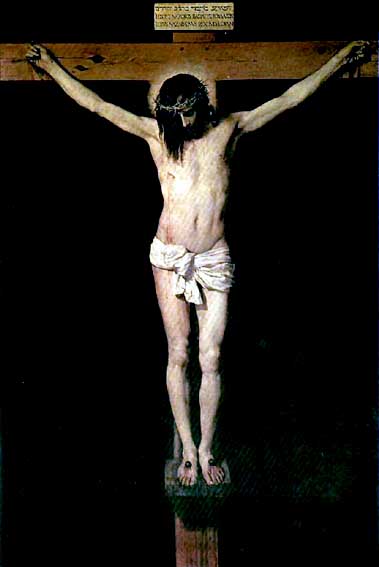
Good Friday: Crucifixion of Our Lord


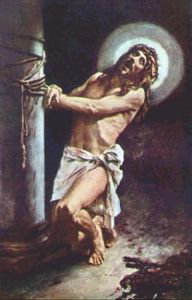
Good Friday: Ecce Homo


Holy Thursday and the Washing of the Feet

A meditation on Lent from The Liturgical Year by Abbot Dom Guéranger, O.S.B.
After having, on this day, washed the feet of His disciples, Jesus said to them: 'Know ye what I have done to you? You call Me Master and Lord: and You say well, for so I am. If then I, being your Lord and Master, have washed your feet; you, also, ought to wash one another's feet. For I have given you an example, that as I have done to you, so you do also.'[1] Although the meaning of these words is that, after the example of our divine Master, we should practice works of fraternal charity towards our neighbour, yet the literal imitation of this our Saviour's act has always been observed in the Church.
At the commencement, it was almost a daily practice. St. Paul, when mentioning the qualities which should adorn the Christian widow, includes that of washing the feet of the saints,[2] that is, of the faithful. We find this act of humble charity practised in the ages of persecution, and even later. TheActs of the saints of the first six centuries, and the homilies and writings of the holy fathers, are filled with allusions to it. Afterwards, charity grew cold, and this particular way of exercising it was confined, almost exclusively, to monasteries. Still, from time to time it was practiced elsewhere. We occasionally find kings and queens setting this example of humility. The holy king Robert of France, and, later, Saint Louis, used frequently to wash the feet of the poor. The holy queen St. Margaret of Scotland, and Saint Elizabeth of Hungary, did the same. The Church, with that spirit which makes her treasure up every recommendation of her divine Lord, has introduced this act of humility into her liturgy, and it is today that she puts the great lesson before her children. In every church of any importance, the prelate, or superior, honours our Saviour's condescension, by the ceremony called the washing of the feet. The bishops throughout the world follow the example set them by the sovereign Pontiff, who performs this ceremony in the Vatican. Yea, there are still to be found kings and queens who, on this day, wash the feet of the poor, and give them abundant alms.
The twelve apostles are represented by the twelve poor who, according to the most general practice, are chosen for this ceremony. The Pope, however, washes the feet of thirteen priests of as many different countries; and this is the reason of the ceremonial requiring this number for cathedral churches. But, why thirteen? Some have interpreted it thus: that it represented the full number of the apostolic college, which is thirteen; for St. Mathias was elected in Judas's place, and our Lord Himself, after His Ascension, called St. Paul to be an apostle. Other authors, however, and among them the learned Pope Benedict XIV,[3] assert that the reason of this number being chosen was the miracle related in the life of St. Gregory the Great. This holy Pope used, every day, to wash the feet of twelve poor men, whom he afterwards invited to his own table. One day, a thirteenth was present: it was an angel, whom God had sent, that He might thereby testify how dear to Him was the charity of His servant.
The ceremony of the washing of the feet is also called the Mandatum, from the first word of the first antiphon. After the deacon has chanted the Gospel of the Mass of Maundy Thursday, the celebrant takes off the cope, girds himself with a towel, and, kneeling down, begins to wash the feet of those who have been chosen. He kisses the right foot of each one after having washed it.
ENDNOTES
1. 1 St. John xiii. 12-15.
2 1 Tim. v. 10.
3 De Festis D. N.J. C. lib. I. cap. vi. no. 57.

Monday, April 8, 2013

He that came by water and blood - The miraculous deluge

From http://newtheologicalmovement.blogspot.ie/2013/04/he-that-came-by-water-and-blood.html

Sunday of Divine Mercy
But after they were come to Jesus, when they saw that he was already dead, they did not break his legs. But one of the soldiers with a spear opened his side: and immediately there came out blood and water. (John 19:33-34)
This is he that came by water and blood, Jesus Christ: not by water only but by water and blood. And it is the Spirit which testifieth that Christ is the truth. (1 John 5:6)
The image of the Divine Mercy recalls the blood and water which gushed forth from the heart of Jesus as a fount of mercy for us. It was after his death, as his lifeless and inanimate body hung upon the Cross, that his holy side and Sacred Heart were opened by a lance, which released upon the earth the flood of God’s mercy.
We may ask: What really happened when the blood and water flowed? Was it natural or miraculous? Just how much blood and how much water came forth? Finally, we do well to consider what was the significance of this blood and water?

Hypovolemic shock and pericardial effusion
There is some biblical evidence to suggest that our Savior had entered into hypovolemic shock after his scourging. Due to the great brutality of the scourging, in which the sacred flesh of our Savior was so torn that his skeletal muscles, veins, sinews, and even his bowels were exposed, our Lord had literally begun to run out of blood in his body. This extreme blood-loss may well have set him into a state of hypovolemic shock which would be occasioned by low blood pressure.
Those in this state of shock will experience dizziness and fainting (and our Lord fell several times as he carried his Cross) as well as extreme thirst and a desire to drink liquids to replenish all the lost fluids (and Jesus said I thirst).
What is particularly pertinent to our discussion is that hypovolemic shock causes a rapid heart-rate which in turn causes a great deal of fluid to gather in the sack around the heart and the lungs. Thus, some suggest that the “blood and water” which came forth could have been this pericardial effusion of fluid.
If such were the case, the blood and water would be mixed together, flowing out as one. Further, the event would not be a miracle, but would be a medically and scientifically explainable phenomenon – something natural.
The miracle
However, St. John refers to the blood and water coming forth not merely as a natural phenomenon which demonstrates our Lord’s bodily death, but even further (especially in 1 John 5:6), as a proof of our Savior’s divinity. Pericardial effusion and hypovolemic shock do very little to prove the divinity of Jesus, thus the “scientific” and “medical” explanation seems contrary to the plain sense of the holy and inerrant Scriptures.
Furthermore, a pericardial effusion does not pertain to the flowing of blood and water, but rather to the pouring forth of various fluids which had built up around the heart. However, St. John does not say that “fluids” poured forth, but that there came out blood and water.
And we are to understand that the blood and water came out separately, not mingled. For, if they had come forth mingled, then the Beloved would not be able to say blood and water, but only blood or fluid – just as we do not say that there is “wine and water” consecrated at the Mass, but only “wine”, since the water is mingled with the wine.
Now, St. John states that there came out blood and water, and this must needs be miraculous for it was not serum, but rather pure blood and pure water which came forth so as to be distinguished one from the other.
It is well worth noting that our Savior himself confirms this interpretation through his Image of Divine Mercy, in which the blue and the red rays are clearly distinct.
A total gift
It is further worth noting that this miraculous pouring forth of blood and water was total and complete. Indeed, the tradition is that our Savior gave forth in this miraculous deluge all the blood and all the water which was in his body. There is no reason why this could not be accomplished by a miracle.
Further, this total gift of blood and water symbolized the total gift of himself, and also the abundance and infinite depths of divine mercy.
The water, the blood, and the Spirit
In his first Epistle, St. John states that the three – the water, the blood, and the Spirit – give testimony. The Fathers and Doctors recognize a spiritual meaning to these three.
First, the literal sense. The “water” and “blood” refer, of course, to the blood and water which poured forth from his sacred side. The “spirit” may refer to the Holy Spirit, but perhaps more likely refers to the Savior’s breath/spirit which he gave up on the Cross.
Just as it was by a miracle that all the blood and water of our Lord’s body immediately gushed forth with great force and yet remained unmingled and most pure, so too it was by a miraculous last breath that our Savior cried out in a loud voice as he gave forth his spirit. For, indeed, those who are dying (especially those dying upon the Cross, which is a quasi-suffocation) are not naturally able to cry out in such a loud voice.
The spiritual sense follows. The water symbolizes baptism. The blood, the Eucharist. And the spirit, the sacrament of Penance – for it was this spirit which Jesus breathed upon his disciples after his resurrection when he gave them the power to absolve sin.
Oh Blood and Water which gushed forth from the Heart of Jesus as a fount of mercy for us, I trust in you!

Thursday, December 27, 2012

The Apparition of Mary to Caesar Augustus at Christmas

From http://cantuar.blogspot.ie/2012/12/the-apparition-of-mary-to-caesar.html

The Roman reign of Caesar Augustus was an era of peace, prosperity, and felicity. Augustus took an imperial census during this era of peace, at which time he closed the temple of Janus for the third time, in the fortieth year of his reign. The Prince of Peace would be born into this historical parenthesis of peace. According to Saint Bede the Venerable, “A lover of peace, He would be born in a time of the most profound quiet. And there could be no plainer indication of peace than that a census should be taken of the whole world, whose master Augustus was, having reigned at the time of Christ’s nativity for some twelve years in the greatest peace, war being lulled to sleep throughout all the world.”[i]
Tradition holds that Caesar Augustus learned from the oracle of the Tiburtine Sybil that a Hebrew child would silence all the oracles of the Roman gods. Tradition also records that the Blessed Virgin Mary, holding the Christ Child in her arms, appeared to Caesar Augustus on the Capital Hill. Augustus recognized that this vision corresponded to the oracle concerning the Hebrew child. In response to this apparition of Mary and Jesus, Augustus built an altar in the Capitol in honor of this child with the title Ara Primogeniti Dei, meaning “Altar of the Firstborn of God.” Over three hundred years later, the Christian emperor Constantine the Great built a church at this location of the apparition and altar, which is called Basilica Sanctae Mariae de Ara Coeli, meaning “Basilica of Saint Mary of the Altar of Heaven.”[ii] 
If one visits the church today, he will observe murals of Caesar Augustus and of the Tiburtine Sibyl painted on either side of the arch above the high altar. These images recall the oracle, which prophesied the advent of the Hebrew “Firstborn of God.” In the fifteenth century, this church became famous for a statue of the Christ Child carved from olive wood taken from the Garden of Gethsemane outside Jerusalem. The church’s connection to the birth of Christ made it a fitting place for devotion to the infancy of the Savior.
Meanwhile in the Jewish district of Rome, on the day of Christ’s nativity, a fountain of oil flowed out from the earth in the tavern of a certain man in what is today called Trastevere—the region south of the Vatican and to the west of the Tiber River. This fountain of oil revealed to the Jews of Rome that the Messiah had at last been born, since Messiah or Christ means “anointed with oil.” To this very day, the Church of Saint Maria in Trastevere marks the location. The Emperor Septimius Severus, who reigned from A.D. 193 to 211, granted the location to the Christians. In A.D. 220, Pope Saint Callixtus I established the site as a church, and his relics still remain under the church’s high altar. The church has been rebuilt several times and can still be visited to this very day.

There are just a couple of interesting connections between Christ and Rome.
This post is derived from Dr. Taylor Marshall's brand new book: The Eternal City: Rome & the Origins of Catholic Christianity. Please continue reading here.

Friday, April 6, 2012

Meditations for Good Friday


From The Liturgical Year by Abbot Dom Guéranger, O.S.B.

THE MORNING: The sun has risen upon Jerusalem. But the priests and scribes have not waited all this time without venting their rage upon Jesus. Annas, who was the first to receive the divine Captive, has had Him taken to his son-in-law Caiphas, the high priest. Here He is put through a series of insulting questions, which disdaining to answer, He receives a blow from one of the high priest’s servants. False witnesses had already been prepared: they now come forward, and depose their lies against Him who is the very Truth: but their testimony is contradictory. Then Caiphas, seeing that this plan for convicting Jesus of blasphemy is only serving to expose his accomplices, turns to another. He asks Him a question, which will oblige our Lord to make an answer; and in this answer he, Caiphas, will discover blasphemy, and blasphemy will bring Jesus under the power of the Synagogue. This is the question: ‘I adjure Thee, by the living God, that Thou tell us, if Thou be the Christ the Son of God! [1] Our Saviour, in order to teach us that we should show respect to those who are in authority, breaks the silence He has hitherto observed, and answers: Thou hast said it: I am: and hereafter ye shall see the Son of Man sitting on the right hand of the power of God, and coming in the clouds of heaven.’ [2] Hereupon, the impious pontiff rises, rends his garments, and exclaims: ‘He hath blasphemed! What further need have we of witnesses? Behold! now ye have heard the blasphemy: what think ye?’ The whole place resounds with the cry: ‘He is guilty of death!’ [3]  
The Son of God has come down upon the earth in order to restore man to life; and yet, here we have this creature of death daring to summon his divine Benefactor before a human tribunal, and condemning Him to death! And Jesus is silent, and bears with these presumptuous, these ungrateful, blasphemers! Well may we exclaim, in the words wherewith the Greek Church frequently interrupts to-day’s reading of the Passion: ‘Glory be to thy patience, O Lord!’  
Scarcely have the terrible words, ‘He is guilty of death,’ been uttered, than the servants of the high priest rush upon Jesus. They spit upon Him, and blindfolding Him, they strike Him, saying: ‘Prophesy, who is it that struck Thee?’ [4] Thus does the Synagogue treat the Messias, who, they say, is to be their glory! And yet, these outrages, frightful as they are, are but the beginning of what our Redeemer has to go through.  
But there is something far more trying than all this to the heart of Jesus, and it is happening at this very time. Peter has made his way as far as the court of the high priest’s palace. He is recognized by the bystanders as a Galilean, and one of Jesus’ disciples. The apostle trembles for his life; he denies his Master, and affirms with an oath that he does not even know Him. What a sad example is here of the punishment of presumption! But Jesus has mercy on His apostle. The servants of the high priest lead Him near to the place where Peter is standing; He casts upon him a look of reproach and pardon; Peter immediately goes forth, and weeps bitterly. From this hour forward he can do nothing but lament his sin; and it is only on Easter morning, when Jesus shall appear to him after His Resurrection, that he will admit any consolation to his afflicted heart. Let us make him our model, now that we are spending these hours, with our holy mother the Church, in contemplating the Passion of Jesus. Peter withdraws, because he fears his own weakness; let us remain to the end, for what have we to fear? May our Jesus give us one of those looks, which can change the hardest and worst of hearts!  
Meanwhile, the day-dawn breaks upon the city, and the chief priests make arrangements for taking Jesus before the Roman governor. They themselves have found Him guilty; they have condemned Him as a blasphemer, and according to the Law of Moses a blasphemer must be stoned to death. But they cannot apply the law: Jerusalem is no longer free, or governed by her own laws. The power over life and death may be exercised only by her conquerors, and that in the name of Cæsar. How is it that these priests and scribes can go through all this, and never once remember the prophecy of Jacob, that the Messias would come when the sceptre should be taken away from Juda? [5] They know off by heart, they are the appointed guardians of, those prophecies, which describe the death to which this Messias is to be put; and yet, they are the very ones who bring it about! How is all this? They are blind, and it is jealousy that blinds them.  
The rumour of Jesus’ having been seized during the night, and that He is on the point of being led before the Roman governor, rapidly spreads through the city, and reaches Judas’ ears. This wretched man had a passion for money, but there was nothing to make him desire the death of his divine Master. He knew Jesus’ supernatural power. He perhaps flattered himself that He, who could command nature and the elements, would easily escape from the hands of His enemies. But now when he sees that He does not escape, and that He is to be condemned to death, he runs to the temple, and gives back the thirty pieces of silver to the chief priests. Is it that he is converted, and is about to ask his Master to pardon him? Alas, no! Despair has possession of him, and he puts an end to his existence. The recollection of all the merciful solicitations made to him, yesterday, by Jesus, both during the last Supper, and in the garden, gives him no confidence; it only serves to increase is despair. Surely, he well knew what a merciful Saviour he had to deal with! And yet, he despairs, and this at the very time when the Blood, which washes away the sins of the whole world, is about to be shed! He is lost, because he despaired.  
The chief priests, taking Jesus with them, present themselves at the governor’s palace, demanding audience for a case of importance. Pilate comes forward, and peevishly asks them: ‘What accusation bring ye against this Man?’ They answer: ‘If He were not a malefactor, we would not have delivered Him up to thee.’ It is very evident, from these first words, that Pilate has a contempt for these Jewish priests; it is not less evident that they are determined to gain their cause. ‘Take Him you,’ says Pilate, ‘and judge Him according to your Law.’ The chief priests answer: ‘It is not lawful for us to put any man to death.’ [6]  
Pilate leaves the hall, in order to speak with these men. He returns, and commands Jesus to be brought in. The Son of God and the representative of the pagan world are face to face. Pilate begins by asking Him: ‘Art Thou the King of the Jews?’ To this Jesus thus replies: ‘My kingdom is not of this world. If My kingdom were of this world, My servants would certainly strive that I should not be delivered to the Jews. But now My kingdom is not from hence’. ‘Art Thou a King, then?’ says Pilate. ‘Thou sayest,’ answers Jesus, ‘that I am a King.’ Having, by these last words, confessed His august dignity, our Lord offers a grace to this Roman; He tells him that there is something worthier of man’s ambition than earthly honours. ‘For this,’ says Jesus, ‘was I born, and for this came I into the world; that I should give testimony to the truth. Every one that is of the truth heareth My voice.’ ‘What is truth?’ asks Pilate; but without waiting for the answer, he leaves Jesus, for he is anxious to have done with this case. He returns to the Jews, and says to them: ‘I find no cause in Him.’ [7] Pilate fancies that this Jesus must be a leader of some Jewish sect, whose teachings give offence to the chief priests, but which are not worth his examining into them: yet at the same time, he is convinced that He is a harmless Man, and that it would be foolish and unjust to accuse Him of disturbing the state. Scarcely has Pilate expressed his opinion in favour of Jesus, than a long list of accusations is brought up against Him by the chief priests. Pilate is astonished at Jesus’ making no reply, and says to Him: ‘Dost Thou not hear how great testimonies they allege against Thee?’ [8] These words are kindly meant, but Jesus still remains silent: they, however, excite His enemies to fresh fury, and they cry out: ‘He stirreth up the people, teaching throughout all Judea, beginning from Galilee, even to this place.’ [9] This word Galilee suggests a new idea to Pilate. Herod, the tetrarch of Galilee, happens to be in Jerusalem at this very time. Jesus is his subject; He must be sent to him. Thus Pilate will get rid of a troublesome case, and this act of courteous deference will re-establish a good understanding between himself and Herod.  
The Saviour is therefore dragged through the streets of Jerusalem, from Pilate’s house to Herod’s palace. His enemies follow Him with relentless fury; but Jesus still observes His noble silence. Herod, the murderer of John the Baptist, insults Him, and ordering Him to be clothed in a white garment, as a fool, he sends Him back to Pilate. Another plan for ridding himself of this troublesome case now strikes the Roman governor. At the feast of the Pasch, he had the power of granting pardon to any one criminal the people may select. They are assembled together at the court-gates. He feels sure that their choice will fall upon Jesus, for it is but a few days ago that they led Him in triumph through the city: besides, he intends to make the alternative one who is an object of execration to the whole people; he is a murderer, and his name Barabbas. ‘Whom will you that I release to you?’ says Pilate: ‘Barabbas, or Jesus, that is called the Christ?’ He has not long to wait for the answer: the crowd exclaim: ‘Not this man, but Barabbas!’ ‘What then,’ replies Pilate, ‘shall I do with Jesus, that is called the Christ?’ ‘Crucify Him.’ ‘Why, what evil hath He done? I will chastise Him, therefore, and let Him go.’ But they, growing irritated at this, cry out so much the louder: ‘Crucify Him! Crucify Him!’ [10]
Pilate’s cowardly subterfuge has failed, and left him in a more difficult position than he was before. His putting the innocent on a level with a murderer was in itself a gross injustice; and yet, he has not gone far enough for a people that is blind with passion. Neither does his promise to chastise Jesus satisfy them: they want more than His Blood; they insist on His death.  
Here let us pause, and offer our Saviour a reparation for the insult He here receives. He is put in competition with a murderer, and the murderer is preferred! Pilate makes an attempt to save Jesus: but on what terms! He must be put on a footing with a vile wretch, and even so be worsted! Those very lips that, a few days back, sang ‘Hosannah to the Son of David,’ now clamour for His crucifixion! The city magistrate and governor pronounces Him innocent, and yet condemns Him to be scourged, because he fears a disturbance!  
Jesus is made over to the soldiers to be scourged. They rudely strip Him of His garments, and tie Him to the pillar which is kept for this kind of torture. Fiercely do they strike Him; the Blood flows down His sacred Body. Let us adore this the second bloodshedding of our Jesus, whereby He expiates the sins we and the whole world have committed by the flesh. This scourging is by the hands of Gentiles: the Jews delivered Him up to be punished, and the Romans were the executioners: thus have we all had our share in the awful deicide.
At last the soldiers are tired; they loose their Victim; but it is not out of anything like pity. Their cruelty is going to rest, and their rest is derision. Jesus has been called King of the Jews: a king, say they, must have a crown! Accordingly, they make one for the Son of David! It is of thorns. They press it violently upon His head, and this is the third bloodshedding of Our Redeemer. Then, that they may make their scoffing perfect, the soldiers throw a scarlet cloak over His shoulders, and put a reed, for a sceptre, into His hand; and bending their knee before Him, they thus salute Him: ‘Hail, King of the Jews!’ This insulting homage is accompanied with blows upon His face; they spit upon Him; and, from time to time, take the reed from His hand, wherewith to strike the thorns deeper into His head.  
Here, the Christian prostrates himself before his Saviour, and says to Him with a heart full of compassion and veneration: ‘Yes! my Jesus! Thou art King of the Jews! Thou art the Son of David, and therefore our Messias and our Redeemer! Israel, that hath so lately proclaimed Thee King, now unkings Thee; the Gentiles scoff at Thy royalty, making it a subject for keener insult; but reign Thou must, and over both Jews and Gentiles: over the Jews, by Thy justice, for they are soon to feel the sceptre of Thy revenge; over the Gentiles, by Thy mercy, for Thine apostles are soon to lead them to Thy feet. Receive, dearest King! our homage and submission! Reign now and for ever over our hearts, yea, over our whole being!’  
Thus mangled and bleeding, holding the reed in His hand, and with the scarlet tatters on His shoulders, Jesus is led back to Pilate. It is just the sight that will soften the hearts of the people; at least, Pilate thinks so; and taking Him with him to a balcony of the palace, he shows Him to the crowd below, saying: ‘Behold the Man!’ [11] Little did Pilate know all that these few words conveyed! He says not: ‘Behold Jesus!’ nor, ‘Behold the King of the Jews!’ He says: ‘Behold the Man!’ Man—the Christian understands the full force of the word thus applied to our Redeemer. Adam, the first man, rebelled against God, and, by his sin, deranged the whole work of the Creator: as a punishment for his pride and intemperance, the flesh tyrannized over the spirit; the very earth was cursed, and thorns were to be its growth. Jesus, the new Man, comes into this world, bearing upon Him, not the reality, but the appearance, the likeness, of sin: in Him, the work of the Creator regains the primeval order; but the change was not wrought without violence. To teach us that the flesh must be brought into subjection to the spirit, Jesus’ Flesh was torn by the scourges; to teach us that pride must give way to humility, the only crown that Jesus wears is made of thorns. Yes, ‘Behold the Man!’ the triumph of the spirit over the flesh, the triumph of humility over pride.  
Like the tiger that grows fiercer as he sees blood, so is Israel at the sight of Jesus after His scourging. ‘Crucify Him! Crucify Him!’—The cry is still the same. ‘Take Him you,’ says Pilate, ‘and crucify Him; for I find no cause in Him.’ And yet, he has ordered Him to be scourged enough to cause His death! Here is another device of the base coward; but it, too, fails. The Jews have their answer ready; they put forward the right granted by the Romans to the nations that are tributary to the empire. ‘We have,’ say they, ‘a law, and according to the law He ought to die; because He made Himself the Son of God.’ Disconcerted by this reply, Pilate takes Jesus aside into the hall, and says to Him: ‘Whence art Thou?’ Jesus is silent; Pilate was not worthy to hear the answer to his question. This silence irritates him. ‘Speakest Thou not to me?’ says he. ‘Knowest Thou not, that I have power to crucify Thee, and I have power to release Thee?’ Here Jesus deigns to speak; and He speaks in order to teach us that every power of government, even where pagans are in question, comes from God, and not from a pretended social compact: ‘Thou shouldst not have any power against Me, unless it were given thee from above. Therefore, he that hath delivered Me to thee, hath the greater sin.’ [12]  
This dignified reply produces an impression upon Pilate: he resolves to make another attempt to save Jesus. But the people vociferate a threat which alarms him: ‘If thou release this Man, thou art not Cæsar’s friend; for whosoever maketh himself a king, speaketh against Cæsar.’ Still, he is determined to try and pacify the crowd. He leaves the hall, sits upon the judgment-seat, orders Jesus to be placed near him, and thus pleads for Him: ‘Behold your King!’ as though he would say, ‘What have you or Cæsar to fear from such a pitiable object as this?’ The argument is unavailing, and only provokes the cry: ‘Away with Him! Away with Him! Crucify Him!’ As though he did not believe them to be in earnest, Pilate says to them: ‘Shall I crucify your King?’ This time the chief priests answer: ‘We have no king but Cæsar.’ [13] When the very ministers of God can talk thus, religion is at an end. No king but Cæsar! Then, the sceptre is taken from Juda, and Jerusalem is cast off, and the Messias is come!  
Pilate, seeing that nothing can quell the tumult, and that his honour as governor is at stake, decides on making Jesus over to His enemies. Though against his own inclination, he passes the sentence, which is to cause him such remorse of conscience that he will afterwards seek relief in suicide. He takes a tablet, and with astyle writes the inscription which is to be fastened to the cross. The people demand that two thieves should be crucified at the same time; it would be an additional insult to Jesus: this, too, he grants, fulfilling the prophecy of Isaias: And with the wicked was He reputed. [14] Having thus defiled his soul with the most heinous of crimes, Pilate washes his hands before the people, and says to them: ‘I am innocent of the Blood of this just Man; look ye to it!’ They answer him with this terrible self-imprecation: ‘His Blood be upon us and upon our children!’ [15] The mark of parricide here fastens on this ungrateful and sacrilegious people; Cain-like, they shall wander fugitives on the earth. Eighteen hundred years have passed since then; slavery, misery, and contempt, have been their portion; but the mark is still upon them. Let us Gentiles—upon whom the Blood of Jesus has fallen as the dew of heaven’s mercy—return fervent thanks to the goodness of our heavenly Father, who hath so loved the world, as to give it His only-begotten Son. [16] Let us give thanks to the Son, who, seeing that our iniquities could not be blotted out save by His Blood, shed it, on this day, even to the very last drop.  
Here commences ‘the way of the cross’: the house of Pilate, where our Jesus receives the sentence of death, is the first station. Our Redeemer is consigned, by the governor’s order, into the hands of the Jews. The soldiers seize Him, and drag Him from the court. They strip Him of the scarlet cloak and bid Him clothe Himself with His own garments as before the scourging. The cross is ready and they put it on His wounded shoulders. The place where the new Isaac loads Himself with the wood of His sacrifice, is the second station. To Calvary!—this is the word of command, and it is obeyed: soldiers, executioners, priests, scribes, people—these form the procession. Jesus moves slowly on; but after a few paces, exhausted by the loss of Blood and by His sufferings, He falls under the weight of His cross. It is the first fall, and marks the third station.  

He falls, not so much by the weight of His cross, as by that of our sins! The soldiers roughly lay their hands on Him, and force Him up again. Scarcely has He resumed His steps, than He is met by His afflicted Mother. The ‘valiant woman’, whose love is stronger than death, was not to be absent at such an hour as this. She must see her Son, follow Him, keep close to Him, even to His last breath. No tongue can tell the poignancy of her grief. The anxiety she has endured during the last few days has exhausted her strength. All the sufferings of Jesus have been made known to her by a divine revelation; she has shared each one of them with Him. But now she cannot endure to be absent, and makes her way through the crowd. The sacrifice is nigh its consummation; no human power could keep such a Mother from her Jesus. The faithful Magdalene is by her side, bathed in tears; John, Mary the mother of James the Less, and Salerno the mother of John, are also with her: they weep for their divine Master, she for her Son. Jesus sees her, but cannot comfort her, for all this is but the beginning of what He is to endure. Oh! what an additional suffering was this for His loving Heart, to see His Mother agonizing with sorrow! The executioners observe the Mother of their Victim, but it would be too much mercy in them to allow her to speak to Him; she may follow, if she please, with the crowd; it is more than she could have expected, to be allowed this meeting, which we venerate as the fourth station of the way of the cross. 
But from this to the last there is a long distance, for there is a law that all criminals are to be executed outside the city walls. The Jews are afraid of Jesus’ expiring before reaching the place of sacrifice. Just at this time, they behold a man coming from the country, by name Simon of Cyrene; they order him to help Jesus to carry His cross. It is out of a motive of cruelty to our Lord, but it gives Simon the honour of sharing with Him the fatigue of bearing the instrument of the world’s salvation. The spot where this happens is the fifth station.  
A little farther on, an incident occurs which strikes the executioners themselves with astonishment. A woman makes her way through the crowd, and setting the soldiers at defiance, comes close up to Jesus. She holds her veil in her hands, and with it respect-fully wipes the face of our Lord, for it is covered with blood, sweat, and spittle. She loves Jesus, and cares not what may happen to her, so she can offer Him this slight comfort. Her love receives its reward: she finds her veil miraculously impressed with the likeness of Jesus’ Face. This courageous act of Veronica marks the sixth station of the way of the cross.  
Jesus grows weaker at each step: He falls a second time: it is the seventh station. Again do the soldiers violently raise Him up, and push Him along the road. It is easy to follow in His footsteps, for a streak of Blood shows where He has passed. A group of women is following close behind the soldiers; they heed not the insults heaped upon them; their compassion makes them brave. But the last brutal treatment’ shown to Jesus is more than they can bear in silence; they utter a cry of pitiful lamentation. Our Saviour is pleased with these women, who, in spite of the weakness of their sex, are showing more courage than all the men of Jerusalem put together. He affectionately turns towards them, and tells them what a terrible chastisement is to follow the crime they are now witnessing. The chief priests and scribes recognize the dignity of the Prophet that had so often spoken to them: they listen with indignation; and, at this the eighth station of the great way, they hear these words: ‘Daughters of Jerusalem! weep not over Me, but weep for yourselves and for your children. For behold the days shall come, wherein they will say: Blessed are the barren, and the wombs that have not borne, and the paps that have not given suck. Then shall they begin to say to the mountains: Fall upon us! And to the hills: Cover us!’ [17]  
At last, they reach the foot of the hill. Calvary is steep; but it is the place of Jesus’ Sacrifice. He begins the ascent, but falls a third time: the hallowed spot is counted as the ninth station. A third time the soldiers force Jesus to rise and continue His painful journey to the summit of the hill, which is to serve as the altar for the holocaust that is to surpass all others in holiness and power. The executioners seize the cross and lay it upon the ground, preparatory to nailing the divine Victim to it. According to a custom practised both by the Romans and the Jews, a cup containing wine and myrrh is offered to Jesus. This drink, which had the bitterness of gall, was given as a narcotic, in order to deaden, in some degree, the feeling of the criminal, and lessen his pain. Jesus raises to His lips the cup, which is proffered Him rather from custom than from any idea of kindness; but He drinks not its contents, for He wishes to feel the full intensity of the suffering He accepts for our sake. Then the executioners, having violently stripped Him of His garments, which had fastened to His wounds, lead Him to the cross. The place where He was thus stripped of His garments, and where the cup of bitter drink was presented to Him, is venerated as the tenth station of the way of the cross. The first nine, from Pilate’s hall to the foot of Calvary, are still to be seen in the streets of Jerusalem; but the tenth and the remaining four are in the interior of the church of Holy Sepulchre, whose spacious walls enclose the spot where the last mysteries of the Passion were accomplished.  
But we must here interrupt our history: we have already anticipated the hours of this great Friday, and we shall have to return, later on, to the hill of Calvary. It is time to assist at the service of our holy mother the Church, in which she celebrates the Death of her divine Spouse. We must not wait for the usual summons of the bells; they are silent; we must listen to the call of our faith and devotion. Let us, then, repair to the house of God.  
 References:
1. St. Matt. xxvi. 63
2. Ibid. 64.—St. Mark xiv. 62.
3. St. Matt. xxvi. 65, 66.
4. St. Luke xxii. 64.
5. Gen. xlix. 10.
6. St. John xviii. 29-31.
7. Ibid.33, 36, 37, 38
8. St. Matt. xxvii. 13.
9. St. Luke xxiii. 5.
10. St. Matt. xxvii.—St. Luke xxiii.—St. John xviii.
11. St. John xix. 5.
12. St. John xix.
13. Ibid.
14. Is liii. 12.
15. St. Matt. xxvii. 24, 25.
16. St. John iii. 16
17. St. Luke xxiii. 28-30.

Good Friday:The Passion of Our Lord


Thursday, December 8, 2011

ASTONISHING REVELATION TO FRENCH NUN BORE STUNNING PARALLEL TO FAMOUS APPARITION

From http://www.spiritdaily.com/sistermary.htm

 An all but unknown 19th-century mystic received dramatic revelations that were stunningly similar to those at the famous apparition in LaSalette, France, but with this twist: her messages came before (as well as during and after) those far better known messages.
The locutions in question -- to an obscure Discalced Carmelite in the French city of Tours named Sister Mary of St. Peter -- were recorded from 1843 to 1847 and -- like LaSalette (exactly) -- focused on the sins of dishonoring the Sabbath and using the Lord's Name in vain.
It was on September 19, 1846, that two children, Mélanie Calvat and Maximim Giraud, tending a cow near the top of a mountain in the French Alps, near Corps, encountered the Blessed Mother. Mary appeared in a globe of light and sat on a rock with her face in her palms, weeping over the sins of mankind.
"I gave you six days to work," the Blessed Mother said, in that Church-approved apparition. "I kept the seventh day for myself, and no one wishes to grant it to me. This is what weighs down the arm of my Son so much. Those who drive carts cannot speak without putting the Name of my Son in the middle."
As a result -- because of this use of Jesus' Name as a swear word, she warned -- the potato crop would be ruined and there would be disease as well as famine.
Precisely this occurred beginning later that very same year as an historic failure of potatoes caused more than a million deaths in northern France and across the English Channel in Ireland (where it was known as the Great Potato Famine).
It was years before, however -- on August 26, 1843 -- that Sister Mary, the mystic in Tours, who had grown up in a devout family, and had early brushes with death, received a similar revelation when there was a "terrible storm during which I felt the Justice of an angry God as I had never before felt it in my life.
"Kneeling, so that my forehead touched the ground, I ceaselessly offered our Savior, Jesus Christ, to His Eternal Father, for the expiation of my sins and for the needs of the Holy Church. I spoke to Him about the incident of the storm. I asked Him to tell me the reason why I felt so strongly on that day the roused anger of His Eternal Father.
"My Name is everywhere blasphemed," Jesus allegedly responded, showing her that such misuse of His Name nullified His redemption and cursed Him to His Face. "There are even children who blaspheme!" the sister heard in locution.
"Our Lord then made me visualize the act of blasphemy as a poisoned arrow continually wounding His Divine Heart," recounted the nun in an autobiography that received the imprimatur of Cardinal Francis Spellman of New York as well as a Nihil Obstat. "After that He revealed to me that He wanted to give me a 'Golden Arrow' which would have the power of wounding Him delightfully, and which would also heal those other wounds inflicted by the malice of sinners."
To repair this outrage, said the religious, the Lord prescribed a prayer of "reparation" that He promised would have special power. On November 10, 1843, Christ also asked for a novena aimed at this same cause.
"Our Lord inspired me at this time to compose certain prayers of reparation in the form of a chaplet, or a small Rosary," she wrote in this fascinating work that has only now come to our attention. "This chaplet is made up of thirty-three small beads, on which is recited thirty-three times the prayer, 'Arise, Oh Lord, and let Your enemies be scattered, and let those that hate You flee before Your Face,' and also six large beads on which are recited the ejaculation, 'My Jesus, mercy,' followed by the doxology, 'Glory be to the Father, etc.'" Sister Mary said Jesus appeared to her in an interior vision and showed precious stones on a fine gold chain as He presented her with a similar chaplet. The devotion brings to mind the Divine Mercy novena devised a century later by Saint Faustina Kowalska in Poland.
But the most electrifying aspect continues to be the warnings on using His Name in vain and violation of the Sabbath.
Two weeks after the aforementioned revelation, Sister Mary said the Lord "seized possession of the powers of my soul" and caused her to hear the following words: "The whole earth is covered with crimes and the violation of the first three of the Ten Commandments of God has aroused the anger of My Father. The crimes that fill up the cup of wickedness are blasphemies against God's Holy Name and the profanation of Sundays. These sins have reached the very Throne of Almighty God, and they have provoked His wrath which is about to strike everywhere unless His Justice be appeased. Never before have these crimes reached such a peak."
That was more than a century and a half ago.
It is daunting to think of how widespread misuse of the Lord's Name has grown in our own time -- amplified by methods of mass communication, including TV, radio, the internet, and at the theatre -- where nearly no modern movie goes by without using the Name of "God" or "Jesus" as a curse word.
"My soul is terrified at what Our Lord has just made me hear during prayer this morning, charging me with the duty of transmitting His message to my superiors without any fear of being deceived," she wrote in her autobiography, The Golden Arrow, which we will be making available. "He said He was incensed with anger against our nation, and that He has sworn in His Wrath to avenge Himself if reparation to the honor of His Divine Father were not made for all the blasphemies of which the people are guilty, making me hear that He could no longer remain among men who, like vipers, were tearing at the entrails of His Mercy."
That was in December of 1843. Sister Mary was 27 at the time. She was later to win the support of her bishop, and died in the odor of sanctity in 1848. Her mission: spreading that remarkable cause of reparation. "Yes, I will grant pardon once more, but mark my word: once!" Jesus responded in regard to her plea to spare France. "And since this crime of blasphemy extends over the whole nation, and since it is public, I demand that Reparation be extended to all the cities of the nation, and that it be public. Woe to those cities that will not make this reparation!"
Woe indeed: other fierce storms were to descend, causing, in one case, an overflowing of the River Loire that the nun described as "so frightful and so unprecedented" that such "had not been seen in centuries."
"The whole city of Tours was in imminent danger as terror and confusion gripped the citizens," she wrote. "Everywhere people acknowledged that an Omnipotent Hand was wielding the elements at will and even those persons who professed hardly any religious belief whatsoever now openly admitted that it was only through a miracle that the whole city of Tours did not perish."
The cause, she said, again: "profanation of Sunday, as Our Lord Himself told me, yet this principal fact was and continues to be ignored" -- again too, as in our time, if not far more so.
Foretelling another disaster that was soon to befall France, the Savior said, "Imagine what will be the state of things in this country when soon My powerful Arm will shake this throne and overthrow him who is now seated thereon."  The following week -- December 2, 1847 -- He said, "The executioners crucified Me on Friday but Christians crucify Me on Sundays."
On February 20, 1848, it was made known to Sister Mary that the crisis of which He spoke -- the "rumbling storm" -- was close at hand: that the Lord "has strung His bow and He is about to discharge His arrows," in the words of these locutions, which garnered the support of her bishop.
Almost immediately after this communication came word of a serious revolution in Paris that shook the very foundations of French government and all of Europe, sending King Louis Philippe fleeing with his family into exile (after eighteen years of secure rule). "The Lord told me that in consequence of the initial efforts made to establish somewhat the Work of Reparation, our country which was to be almost entirely destroyed by the darts of His Justice would now only be partly punished by the terrible flames of His Anger," wrote Sister Mary in this revelation that preceded the far better known Divine Mercy ones. "Oh, how I long entreat all the bishops to establish the Work of Reparation in their dioceses."
To console Him, she also was given a devotion to His Holy Face and led to know that daily glorifying the Holy Name of God was crucial.
It was through the Holy Face -- in our time, best represented by the Shroud of Turin, in hers, the "Veil of Veronica" -- that she said His anger is appeased. "You cannot comprehend the malice and abomination of this sin," Jesus had said in 1848, referring to blasphemy. "If My Justice were not restrained by My Mercy, indeed, it would instantly crush the guilty. In fact, all creatures, even those that are inanimate, would avenge this outrage against their Creator's Majesty, but I have eternity in which to punish the guilty." 
That uncannily parallels LaSalette, where -- referring to neglect of Sunday and use of profanation -- the Blessed Mother intoned, "These are the two things which weigh down the Arm of my Son so much." And alluding to the potatoes, she said, "They will continue to go bad; at Christmas there will be none left."
[resources: The Golden Arrow]