Showing posts with label Pope John Paul II. Show all posts
Showing posts with label Pope John Paul II. Show all posts
Wednesday, May 14, 2014

Sunday, April 27, 2014
Popes John Paul II, John XXIII officially declared saints
.
In a packed St. Peter's Square at the Vatican on Divine Mercy Sunday, Pope Francis officially declared former pontiffs John Paul II and John XXIII as Saints.
“For the honor of the Blessed Trinity, the exaltation of the Catholic faith and the increase of the Christian life, by the authority of our Lord Jesus Christ and of the Holy Apostles Peter and Paul and having sought the council of many of our brother Bishops, we declare and define Blessed John XXIII and John Paul II be Saints,” Pope Francis exclaimed April 27 as the crowds cheered.
“We enroll them among the Saints, decreeing that they are to be venerated as such by the whole Church. In the name of the Father, and of the Son, and of the Holy Spirit.”
Throngs of pilgrims flooded the Vatican on Divine Mercy Sunday to celebrate the highly anticipated canonizations of now-Saints John Paul II and John XXIII.
Pope John XXIII was born in Sotto il Monte, a diocese and province of Bergamo, Italy, Nov. 25, 1881 as fourth of 13 children. He was elected Roman Pontiff Oct. 28, 1958.
Known as “Good Pope John,” he is most remembered for his historic encyclical “Pacem in Terris,” and for his calling of the Second Vatican Council.
He was declared Blessed by Pope John Paul II Sept. 3, 2000, during celebration of the Great Jubilee Year in 2000, and was approved for canonization by Pope Francis last July.
Saint John Paul II is perhaps one of the most well-known pontiffs in recent history, and is most remembered for his charismatic nature, his love of youth and his world travels, along with his role in the fall of communism in Europe during his 27-year papacy.
The cherished Polish Pope died in 2005, marking his 2011 beatification as one of the quickest in recent Church history, and is the first Pope to be beatified by his immediate successor.
In an April 24 message sent to both the Church in Poland and the diocese of Bergamo, Italy, Pope Francis thanked each for the great “gift” of the Saints for the Church and for the world, saying of John Paul II that he is grateful, “as all the members of the people of God, for his untiring service, his spiritual guidance, and for his extraordinary testimony of holiness.”
Speaking of Saint John XXIII’s historic calling of the Second Vatican Council in order to address a pastoral response to the presence of the Church in the modern world, the Roman Pontiff explained that “the renewal desired from the Second Vatican Council has opened the road.”
It is “a special joy that the canonization of Pope Roncalli takes place together with that of Bl. John Paul II,” he continued, adding that “this renewal has brought forward in his long pontificate.”
Seated alongside the cardinals in attendance for the canonization is retired pontiff Benedict XVI, making this the first Mass in history concelebrated by a Pope and his predecessor.
In a packed St. Peter's Square at the Vatican on Divine Mercy Sunday, Pope Francis officially declared former pontiffs John Paul II and John XXIII as Saints.
“For the honor of the Blessed Trinity, the exaltation of the Catholic faith and the increase of the Christian life, by the authority of our Lord Jesus Christ and of the Holy Apostles Peter and Paul and having sought the council of many of our brother Bishops, we declare and define Blessed John XXIII and John Paul II be Saints,” Pope Francis exclaimed April 27 as the crowds cheered.
“We enroll them among the Saints, decreeing that they are to be venerated as such by the whole Church. In the name of the Father, and of the Son, and of the Holy Spirit.”
Throngs of pilgrims flooded the Vatican on Divine Mercy Sunday to celebrate the highly anticipated canonizations of now-Saints John Paul II and John XXIII.
Pope John XXIII was born in Sotto il Monte, a diocese and province of Bergamo, Italy, Nov. 25, 1881 as fourth of 13 children. He was elected Roman Pontiff Oct. 28, 1958.
Known as “Good Pope John,” he is most remembered for his historic encyclical “Pacem in Terris,” and for his calling of the Second Vatican Council.
He was declared Blessed by Pope John Paul II Sept. 3, 2000, during celebration of the Great Jubilee Year in 2000, and was approved for canonization by Pope Francis last July.
Saint John Paul II is perhaps one of the most well-known pontiffs in recent history, and is most remembered for his charismatic nature, his love of youth and his world travels, along with his role in the fall of communism in Europe during his 27-year papacy.
The cherished Polish Pope died in 2005, marking his 2011 beatification as one of the quickest in recent Church history, and is the first Pope to be beatified by his immediate successor.
In an April 24 message sent to both the Church in Poland and the diocese of Bergamo, Italy, Pope Francis thanked each for the great “gift” of the Saints for the Church and for the world, saying of John Paul II that he is grateful, “as all the members of the people of God, for his untiring service, his spiritual guidance, and for his extraordinary testimony of holiness.”
Speaking of Saint John XXIII’s historic calling of the Second Vatican Council in order to address a pastoral response to the presence of the Church in the modern world, the Roman Pontiff explained that “the renewal desired from the Second Vatican Council has opened the road.”
It is “a special joy that the canonization of Pope Roncalli takes place together with that of Bl. John Paul II,” he continued, adding that “this renewal has brought forward in his long pontificate.”
Seated alongside the cardinals in attendance for the canonization is retired pontiff Benedict XVI, making this the first Mass in history concelebrated by a Pope and his predecessor.

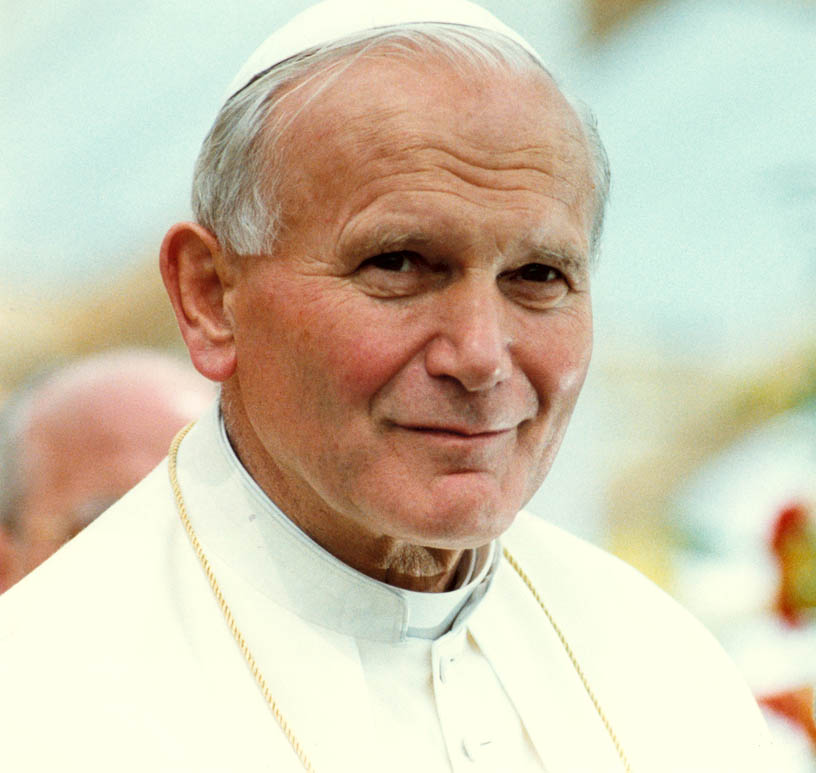
Monday, January 27, 2014
Pope John Paul ll relic stolen from chapel in Italy
From http://www.bbc.co.uk/news/world-europe-25911872
Italian police are hunting for a stolen holy relic that contains the blood of Pope John Paul ll.
It appears to have been taken during the burglary of a small chapel that was a place of special significance to the late Pope.
The church of San Pietro della Ienca lies in an isolated spot in the mountains of central Abruzzo region.
Over the weekend, thieves broke some protective iron bars and forced their way in through a window.
They left the collection box, but took a crucifix and the priceless relic, which contains a piece of gauze once soaked in the blood of the late Pope - one of only three such relics in the world.
Members of the local cultural association supporting the chapel are distraught.
"We are very displeased by the theft. We have no idea of who could have done it. The police are carrying out a search," said Franca Corrieri, a member of the association, speaking to the BBC.
The Pope used to escape the pressures of life in the Vatican by coming to the mountains.
"This is an area that John Paul II visited often, with his secretary and not too many bodyguards. We feel very connected to him. After his death, his secretary, Cardinal Stanislaw Dziwisz, came and told us that he wanted this church to become a sanctuary," said Ms Corrieri.
Dozens of police officers are now searching the area with sniffer dogs.
Friday, July 5, 2013
Blessed John Paul II to be Canonized after second miracle, Vatican Confirms, along with Blessed John XXIII forgoing second miracle for him
From http://www.ncregister.com/blog/edward-pentin/blesseds-john-paul-ii-and-john-xxiii-to-be-canonized
Read more: http://www.ncregister.com/blog/edward-pentin/blesseds-john-paul-ii-and-john-xxiii-to-be-canonized#ixzz2YCFMmbl7
The Vatican has today confirmed that Blessed Pope John Paul II will be
canonized, although a date has not yet been set for the ceremony.
Reading from a statement, Vatican spokesman Father Federico Lombardi told reporters this afternoon that Pope Francis had approved a decree on a miracle attributed to John Paul's intercession. He also said the Holy Father had approved a “favourable vote”, taken by a commission of cardinals and bishops, “on the canonization of Blessed Pope John XXIII.”
The commission has decided to “convoke a consistory” so that both canonizations can take place at the same time, but it's not clear yet when as Pope Francis wants to hear the opinions of cardinals first.
“No date has been set,” Father Lombardi said, “but it is very likely that there will be one canonisation ceremony before the end of the year.”
Although a miracle has not been found due to John XXIII's intercession since his beatification in 2000, Father Lombardi said that in this case, Pope Francis has agreed to skip the usual second miracle required for canonization.
Concerning the miracle attributed to John Paul II’s intercession, the Vatican has yet to release details, but it is understood to concern the healing of a severely ill woman from Costa Rica.
Spanish newspaper La Razon has identified her as Floribeth Mora, and said she suffered from a cerebral aneurism that was inexplicably cured on May 1, 2011 — the very day of John Paul's beatification. Her family were praying for her at the time; she had been given only a month to live.
Her doctor, Dr. Alejandro Vargas, told La Razon that the disappearance of the aneurism “surprised me a lot” and that he couldn’t explain it “based on science." Some reports say the exact details of the miracle, which will "amaze the world", will be revealed later today by Costa Rican doctors.
The first miracle that led to John Paul II’s beatification in 2011 concerned Sister Marie Simon Pierre, whose recovery from Parkinson's disease could not be explained by a Vatican panel of medical experts.
***
Today’s announcement was part of a series of decrees issued today for sainthood causes. Among them was a decree approving a miracle needed for the beatification of the Venerable Alvaro del Portillo who succeeded St. Josemaria Escriva as the Prelate of Opus Dei.
The miracle involves the instantaneous healing of Chilean new born baby Jose Ignacio Ureta Wilson. Soon after birth in August 2003, he suffered a cardiac arrest lasting longer than 30 minutes, and a massive haemorrhage. His parents prayed "with great faith" through the intercession of Bishop Alvaro del Portillo, says Manuel Fandila Sanchez, spokesman of Opus Dei. "When the medical team thought that the baby had died, without any additional treatment and in a totally unexpected way, the heart of the new born baby started to beat again, reaching 130 beats per minute."
Ten years later, Jose Ignacio "leads a normal life."
As with John Paul II, Bishop Alvaro's cause brought to light numerous other accounts of favours received through his intercession. Opus Dei says that Bishop Alvaro's beatification "will most likely take place in Rome," which is where he died.
Born in Madrid on 11 March 1914, Alvaro del Portillo was known as a “profoundly good and amiable man, able to transmit peace and serenity to souls.” As well as being Prelate of Opus Dei and among other achievements and acts of holiness, he carried out numerous tasks for the Holy See, including taking an active role in the Second Vatican Council and was for many years consultor for the Congregation for the Doctrine of the Faith.
Reading from a statement, Vatican spokesman Father Federico Lombardi told reporters this afternoon that Pope Francis had approved a decree on a miracle attributed to John Paul's intercession. He also said the Holy Father had approved a “favourable vote”, taken by a commission of cardinals and bishops, “on the canonization of Blessed Pope John XXIII.”
The commission has decided to “convoke a consistory” so that both canonizations can take place at the same time, but it's not clear yet when as Pope Francis wants to hear the opinions of cardinals first.
“No date has been set,” Father Lombardi said, “but it is very likely that there will be one canonisation ceremony before the end of the year.”
Although a miracle has not been found due to John XXIII's intercession since his beatification in 2000, Father Lombardi said that in this case, Pope Francis has agreed to skip the usual second miracle required for canonization.
Concerning the miracle attributed to John Paul II’s intercession, the Vatican has yet to release details, but it is understood to concern the healing of a severely ill woman from Costa Rica.
Spanish newspaper La Razon has identified her as Floribeth Mora, and said she suffered from a cerebral aneurism that was inexplicably cured on May 1, 2011 — the very day of John Paul's beatification. Her family were praying for her at the time; she had been given only a month to live.
Her doctor, Dr. Alejandro Vargas, told La Razon that the disappearance of the aneurism “surprised me a lot” and that he couldn’t explain it “based on science." Some reports say the exact details of the miracle, which will "amaze the world", will be revealed later today by Costa Rican doctors.
The first miracle that led to John Paul II’s beatification in 2011 concerned Sister Marie Simon Pierre, whose recovery from Parkinson's disease could not be explained by a Vatican panel of medical experts.
***
Today’s announcement was part of a series of decrees issued today for sainthood causes. Among them was a decree approving a miracle needed for the beatification of the Venerable Alvaro del Portillo who succeeded St. Josemaria Escriva as the Prelate of Opus Dei.
The miracle involves the instantaneous healing of Chilean new born baby Jose Ignacio Ureta Wilson. Soon after birth in August 2003, he suffered a cardiac arrest lasting longer than 30 minutes, and a massive haemorrhage. His parents prayed "with great faith" through the intercession of Bishop Alvaro del Portillo, says Manuel Fandila Sanchez, spokesman of Opus Dei. "When the medical team thought that the baby had died, without any additional treatment and in a totally unexpected way, the heart of the new born baby started to beat again, reaching 130 beats per minute."
Ten years later, Jose Ignacio "leads a normal life."
As with John Paul II, Bishop Alvaro's cause brought to light numerous other accounts of favours received through his intercession. Opus Dei says that Bishop Alvaro's beatification "will most likely take place in Rome," which is where he died.
Born in Madrid on 11 March 1914, Alvaro del Portillo was known as a “profoundly good and amiable man, able to transmit peace and serenity to souls.” As well as being Prelate of Opus Dei and among other achievements and acts of holiness, he carried out numerous tasks for the Holy See, including taking an active role in the Second Vatican Council and was for many years consultor for the Congregation for the Doctrine of the Faith.
Read more: http://www.ncregister.com/blog/edward-pentin/blesseds-john-paul-ii-and-john-xxiii-to-be-canonized#ixzz2YCFMmbl7
Wednesday, June 19, 2013
Saturday, December 31, 2011
Documents show how Pope tried to end Irish inmates' 1981 hunger strike
By Michael Kelly
Catholic News Service
DUBLIN (CNS) -- Declassified British documents reveal the extent to which Pope John Paul II tried unsuccessfully to intervene to end a 1981 hunger strike by Catholic prisoners in a British jail in Northern Ireland.
The documents claim that, after the pope sent a special envoy, the leader of the Provisional Irish Republican Army prisoners, Bobby Sands, was willing to suspend the fast just days before he died.
The offer was conveyed to the British authorities by the pope's secretary, Irish Msgr. John Magee, whom Pope John Paul dispatched to persuade the prisoners to call off the hunger strike.
The state papers, declassified under the 30-year-rule, claim that Sands told Msgr. Magee, who later became the bishop of Cloyne, that he would suspend his strike in return for discussions with a British government official, two priests and three other prisoners as witnesses.
However, the British rejected the offer, claiming it was an attempt to open negotiations. The prisoners, incarcerated for paramilitary activity against British rule in Northern Ireland, had begun their hunger strike in a bid to be reclassified as political prisoners, a move Britain vehemently rejected.
Sands died May 5, 1981, after 66 days on hunger strike; he was buried with a crucifix that Msgr. Magee had given him as a gift from Pope John Paul. Ten prisoners starved themselves to death before a compromise was reached that October.
The hunger strike significantly polarized tensions between the majority-Protestant and minority-Catholic communities in Northern Ireland. More than 100,000 Catholics attended Sands' funeral, and Sinn Fein, the political wing of the Irish Republican Army, began contesting elections for the first time.
Most Northern Irish Catholics want Britain to cede the region to the Irish Republic to form a single independent Ireland, while most Protestants support the region's continuation in the United Kingdom. A 1998 peace accord committed all sides to pursue their goals by purely peaceful means. As a result, Northern Ireland remains part of the United Kingdom but is governed by a cross-community power-sharing government based in Belfast, Northern Ireland.
The declassified papers also reveal that Irish Prime Minister Garret FitzGerald appealed to Cardinal Tomas O Fiaich in 1981 for a change in the Catholic Church's approach to interchurch marriages.
At the time, children of interchurch marriages were required to be raised Catholic.
But FitzGerald said he believed a change would aid peace and reconciliation in Northern Ireland. He wrote the cardinal that the government wanted to "indicate concern" and "raise the possibility" that the Vatican "might not perhaps be disposed to take special account of the Irish situation if invited to do so."
"I trust that Your Eminence will appreciate and understand the motives that have led me to write to you at this time in these terms, in full recognition of the separation of church and state," he added.
Soon after, the Irish bishops decided to postpone publication of a revised directory on mixed marriages. After a meeting with British Prime Minister Margaret Thatcher in November 1981, FitzGerald described the bishops' postponement as "significant."
The new directory issued in November 1983 retained the promise by the Catholic partner to raise the children Catholic, but stressed that parents had joint responsibility for the religious upbringing of their children.
Catholic News Service
DUBLIN (CNS) -- Declassified British documents reveal the extent to which Pope John Paul II tried unsuccessfully to intervene to end a 1981 hunger strike by Catholic prisoners in a British jail in Northern Ireland.
The documents claim that, after the pope sent a special envoy, the leader of the Provisional Irish Republican Army prisoners, Bobby Sands, was willing to suspend the fast just days before he died.
The offer was conveyed to the British authorities by the pope's secretary, Irish Msgr. John Magee, whom Pope John Paul dispatched to persuade the prisoners to call off the hunger strike.
The state papers, declassified under the 30-year-rule, claim that Sands told Msgr. Magee, who later became the bishop of Cloyne, that he would suspend his strike in return for discussions with a British government official, two priests and three other prisoners as witnesses.
However, the British rejected the offer, claiming it was an attempt to open negotiations. The prisoners, incarcerated for paramilitary activity against British rule in Northern Ireland, had begun their hunger strike in a bid to be reclassified as political prisoners, a move Britain vehemently rejected.
Sands died May 5, 1981, after 66 days on hunger strike; he was buried with a crucifix that Msgr. Magee had given him as a gift from Pope John Paul. Ten prisoners starved themselves to death before a compromise was reached that October.
The hunger strike significantly polarized tensions between the majority-Protestant and minority-Catholic communities in Northern Ireland. More than 100,000 Catholics attended Sands' funeral, and Sinn Fein, the political wing of the Irish Republican Army, began contesting elections for the first time.
Most Northern Irish Catholics want Britain to cede the region to the Irish Republic to form a single independent Ireland, while most Protestants support the region's continuation in the United Kingdom. A 1998 peace accord committed all sides to pursue their goals by purely peaceful means. As a result, Northern Ireland remains part of the United Kingdom but is governed by a cross-community power-sharing government based in Belfast, Northern Ireland.
The declassified papers also reveal that Irish Prime Minister Garret FitzGerald appealed to Cardinal Tomas O Fiaich in 1981 for a change in the Catholic Church's approach to interchurch marriages.
At the time, children of interchurch marriages were required to be raised Catholic.
But FitzGerald said he believed a change would aid peace and reconciliation in Northern Ireland. He wrote the cardinal that the government wanted to "indicate concern" and "raise the possibility" that the Vatican "might not perhaps be disposed to take special account of the Irish situation if invited to do so."
"I trust that Your Eminence will appreciate and understand the motives that have led me to write to you at this time in these terms, in full recognition of the separation of church and state," he added.
Soon after, the Irish bishops decided to postpone publication of a revised directory on mixed marriages. After a meeting with British Prime Minister Margaret Thatcher in November 1981, FitzGerald described the bishops' postponement as "significant."
The new directory issued in November 1983 retained the promise by the Catholic partner to raise the children Catholic, but stressed that parents had joint responsibility for the religious upbringing of their children.
Monday, May 2, 2011

Friday, April 29, 2011
John Paul II remains moved in front of St. Peter’s tomb
.
The casket containing the mortal remains of Pope John Paul II has been exhumed ahead of his beatification this Sunday.
The brief ceremony of exhumation took place in the early hours of this morning in the grotto situated beneath the high altar of St. Peter’s Basilica.
The tomb of Pope John Paul was opened and his casket placed on a cart. The casket, however, remained unopened throughout and was covered with a large pall embroidered with gold.
Papal caskets are comprised of three components. The outside box is a wooden one, inside of that is a lead container, and the final casket--which contains the remains of the Pope--is also made of wood. Those present at the exhumation say the wooden outer layer of the casket had slightly deteriorated with age.
At 9a.m., prayers and the singing of the litany of saints were led by the cleric in charge of the basilica, Cardinal Angelo Comastri. Those joining him included Pope John Paul’s former private secretary, Cardinal Stanislaw Dziwisz, and the Vatican’s Secretary of State, Cardinal Tarcisio Bertone.
Accompanied by the Swiss Guard and Vatican Gendarmerie, the coffin was then translated the short distance to the tomb of St. Peter. It will remain there until the early hours of Sunday morning when it will be transferred to the foot of the high altar in the basilica above. It is here that pilgrims will be able to pay homage to the late pontiff on Sunday and Monday.
After every pilgrim has had a chance to pray in front of the casket, the coffin will be taken to its final resting place in the chapel of St. Sebastian, which is situated next to Michelangelo’s Pieta near the basilica’s entrance.
Meanwhile, the large tombstone which has covered the late Pope’s grave for the past six years will be taken to the Polish city of Krakow where it will be placed in a new church dedicated to Blessed John Paul.
Tuesday, April 12, 2011
Vatican announces Masses, Oct. 22 feast day for Blessed John Paul
By Cindy Wooden
Catholic News Service
VATICAN CITY (CNS)
The feast day of Blessed John Paul II will be marked Oct. 22 each year in Rome and the dioceses of Poland.
When the Vatican made the announcement April 11, it also said Catholics throughout the world will have a year to celebrate a Mass in thanksgiving for his beatification. While thanksgiving Masses for a beatification -- like the observance of a feast day -- usually are limited to places where the person lived or worked, "the exceptional character of the beatification of the Venerable John Paul II, recognized by the entire Catholic Church spread throughout the world," led to a general permission for the thanksgiving Mass, said a decree from the Congregation for Divine Worship and the Sacraments.
The decree was published in the Vatican newspaper, L'Osservatore Romano, and included information about the thanksgiving Mass, Pope John Paul's feast day, annual Masses in his honor and naming churches after him. The newspaper also published the text of the opening prayer -- formally the "collect" -- for his feast day Mass in Latin, English, French, German, Spanish, Italian, Portuguese and Polish.
A local bishop or the superior general of a religious order is free to choose the day or dates as well as the place or places for the thanksgiving Mass, as long as the Masses are celebrated by May 1, 2012, which is one year after the beatification, the decree said.
In the Diocese of Rome, where Pope John Paul served as bishop, and in all the dioceses of his native Poland, his feast day is to be inserted automatically into the annual calendar, the decree said. Oct. 22 was chosen as the day to remember him because it is the anniversary of the liturgical inauguration of his papacy in 1978.
Outside Rome and Poland, bishops will have to file a formal request with the Vatican to receive permission to mark the feast day, the decree said. The local-only celebration of a blessed's feast is one of the most noticeable differences between being beatified and being canonized, which makes universal public liturgical veneration possible.
The only places where parishes and churches can be named after Blessed John Paul without special Vatican permission are in the Diocese of Rome and the dioceses of Poland or other places that have obtained specific Vatican permission to insert Pope John Paul's Oct. 22 feast in their liturgical calendar, the decree said.
The text of the opening prayer for the Mass in honor of Blessed John Paul is: "O God, who are rich in mercy and who willed that the Blessed John Paul II should preside as pope over your universal church, grant, we pray, that instructed by his teaching, we may open our hearts to the saving grace of Christ, the sole redeemer of mankind. Who lives and reigns."
Catholic News Service
VATICAN CITY (CNS)
The feast day of Blessed John Paul II will be marked Oct. 22 each year in Rome and the dioceses of Poland.
When the Vatican made the announcement April 11, it also said Catholics throughout the world will have a year to celebrate a Mass in thanksgiving for his beatification. While thanksgiving Masses for a beatification -- like the observance of a feast day -- usually are limited to places where the person lived or worked, "the exceptional character of the beatification of the Venerable John Paul II, recognized by the entire Catholic Church spread throughout the world," led to a general permission for the thanksgiving Mass, said a decree from the Congregation for Divine Worship and the Sacraments.
The decree was published in the Vatican newspaper, L'Osservatore Romano, and included information about the thanksgiving Mass, Pope John Paul's feast day, annual Masses in his honor and naming churches after him. The newspaper also published the text of the opening prayer -- formally the "collect" -- for his feast day Mass in Latin, English, French, German, Spanish, Italian, Portuguese and Polish.
A local bishop or the superior general of a religious order is free to choose the day or dates as well as the place or places for the thanksgiving Mass, as long as the Masses are celebrated by May 1, 2012, which is one year after the beatification, the decree said.
In the Diocese of Rome, where Pope John Paul served as bishop, and in all the dioceses of his native Poland, his feast day is to be inserted automatically into the annual calendar, the decree said. Oct. 22 was chosen as the day to remember him because it is the anniversary of the liturgical inauguration of his papacy in 1978.
Outside Rome and Poland, bishops will have to file a formal request with the Vatican to receive permission to mark the feast day, the decree said. The local-only celebration of a blessed's feast is one of the most noticeable differences between being beatified and being canonized, which makes universal public liturgical veneration possible.
The only places where parishes and churches can be named after Blessed John Paul without special Vatican permission are in the Diocese of Rome and the dioceses of Poland or other places that have obtained specific Vatican permission to insert Pope John Paul's Oct. 22 feast in their liturgical calendar, the decree said.
The text of the opening prayer for the Mass in honor of Blessed John Paul is: "O God, who are rich in mercy and who willed that the Blessed John Paul II should preside as pope over your universal church, grant, we pray, that instructed by his teaching, we may open our hearts to the saving grace of Christ, the sole redeemer of mankind. Who lives and reigns."
Sunday, January 16, 2011
Friday, January 14, 2011
Thursday, January 13, 2011
Tuesday, November 24, 2009
Did Pope John Paul II self-flagellate?
From www.telegraph.co.uk
By Nick Pisa in Perugia
Published: 6:00AM GMT 23 Nov 2009
The Pope, who died five years ago, is being considered for sainthood by the Catholic Church.
As part of the Vatican's investigation thousands of documents have been collected and examined by officials from the Congregation for the Causes of Saints.
Among them is the testimony of Tobiana Sobodka, a Polish nun of the Sacred Heart of Jesus order, who worked for Pope John Paul in his private Vatican apartments and at his summer residence in Castel Gandolfo near Rome.
Sister Sobodka said: "Several times he (Pope John Paul) would put himself through bodily penance.
"We would hear it – we were in the next room at Castel Gandolfo. You could hear the sound of the blows when he flagellate himself. He did it when he was still capable of moving on his own."
The flagellation is also confirmed by another bishop who has given testimony. Emery Kabongo was a secretary for Pope John Paul.
"He would punish himself and in particular just before he ordained bishops and priests," he said.
"I never actually saw it myself but several people told me about it."
Self flagellation is sometimes used by devoted Catholics as it reminds them of the whipping endured by Christ at the hands of the Romans before he was crucified.
It is still common in the Philippines and Latin America, some members of strict monastic orders and some members of the lay organisation Opus Dei – who feature in the Dan Brown blockbuster The Da Vinci Code.
In the film – which was condemned by the Vatican – murderous Albino monk Silas, who is a member of Opus Dei is seen in a brutal scene whipping his back and drawing blood as he prays on his knees.
A Vatican spokesman said: "The investigation and documentation is still secret and as such we can make no comment on it until the final report is published.
"I know that the nun in question has returned to Poland and she would have spoken with the Congregation as she was with an order that worked in the apartments of Pope John Paul."
The Congregation for the Causes of Saints has been investigating the case for Pope John Paul since he died and has approved the late pope's "heroic virtues" and the paperwork has been sent to his German successor.
The late Polish pope's beatification is expected to take place sometime next year, perhaps in April, to coincide with the fifth anniversary of his death or in October to coincide with his election in 1978.
By Nick Pisa in Perugia
Published: 6:00AM GMT 23 Nov 2009
The Pope, who died five years ago, is being considered for sainthood by the Catholic Church.
As part of the Vatican's investigation thousands of documents have been collected and examined by officials from the Congregation for the Causes of Saints.
Among them is the testimony of Tobiana Sobodka, a Polish nun of the Sacred Heart of Jesus order, who worked for Pope John Paul in his private Vatican apartments and at his summer residence in Castel Gandolfo near Rome.
Sister Sobodka said: "Several times he (Pope John Paul) would put himself through bodily penance.
"We would hear it – we were in the next room at Castel Gandolfo. You could hear the sound of the blows when he flagellate himself. He did it when he was still capable of moving on his own."
The flagellation is also confirmed by another bishop who has given testimony. Emery Kabongo was a secretary for Pope John Paul.
"He would punish himself and in particular just before he ordained bishops and priests," he said.
"I never actually saw it myself but several people told me about it."
Self flagellation is sometimes used by devoted Catholics as it reminds them of the whipping endured by Christ at the hands of the Romans before he was crucified.
It is still common in the Philippines and Latin America, some members of strict monastic orders and some members of the lay organisation Opus Dei – who feature in the Dan Brown blockbuster The Da Vinci Code.
In the film – which was condemned by the Vatican – murderous Albino monk Silas, who is a member of Opus Dei is seen in a brutal scene whipping his back and drawing blood as he prays on his knees.
A Vatican spokesman said: "The investigation and documentation is still secret and as such we can make no comment on it until the final report is published.
"I know that the nun in question has returned to Poland and she would have spoken with the Congregation as she was with an order that worked in the apartments of Pope John Paul."
The Congregation for the Causes of Saints has been investigating the case for Pope John Paul since he died and has approved the late pope's "heroic virtues" and the paperwork has been sent to his German successor.
The late Polish pope's beatification is expected to take place sometime next year, perhaps in April, to coincide with the fifth anniversary of his death or in October to coincide with his election in 1978.
Subscribe to:
Posts (Atom)