Mayo Life Network have announced a Rally for Life for the 3rd of November in Castlebar, Co. Mayo. They believe it will give the people of Mayo and the rest of Ireland the chance to remind An Taoiseach Enda Kenny that the majority of voters remain firmly opposed to the introduction of abortion in Ireland.
At 1p.m. 3rd November, The Mall, Castlebar, Co. Mayo
For Bus Information, Call: 087 7020255
Saturday, October 20, 2012

Tuesday, October 16, 2012
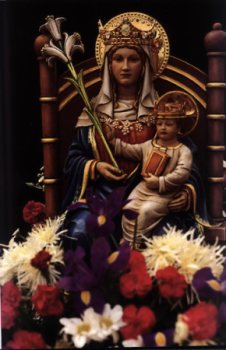
England's Unknown Marian Apparition: Our Lady of Walsingham
Canterbury Tales September 25, 2012:
 Most Catholics know of France's famous Marian apparitions, such
as those at Lourdes and Rue du Bac, and also the greater Marian
apparition sites such as the one at Fatima, Portugal or
Guadalupe, Mexico.
Most Catholics know of France's famous Marian apparitions, such
as those at Lourdes and Rue du Bac, and also the greater Marian
apparition sites such as the one at Fatima, Portugal or
Guadalupe, Mexico.England's once famous shrine of Our Lady of Walsingham is not as well known due to the onset of Protestantism in the 1500s. Thankfully, the apparition is receiving greater devotion due to the efforts of Catholics and Anglicans with a love for the Blessed Virgin.
The tradition of Our Lady of Walsingham began with an apparition of the Immaculate Mother of God to Richeldis de Faverches, a Catholic English noblewoman, in 1061 in the village of Walsingham in Norfolk, England.
The Mother of God revealed the archetectural plans of the Holy House of the Holy Family in Nazareth and she asked Lady Richeldis to build the house as a shrine and place of pilgrimage.
The Holy House of Walsingham was an exact copy of of the home in which the Annunciation occurred. The chapel was founded in the time of Edward the Confessor, about 1053, the earliest deeds naming Richeldis, the mother of Geoffrey of Favraches as the founder. In 1169, Geoffrey granted 'to God and St. Mary and to Edwy his clerk the chapel of our Lady' which his mother had founded at Walsingham with the intention that Edwy should found a priory. These gifts were, shortly afterwards, confirmed to the Austin Canons of Walsingham by Robert de Brucurt and Roger, earl of Clare.
By 1500, Our Lady of Walsingham had become one of the greatest religious centres in England, and Europe, together with Glastonbury and Canterbury. It became the third most popular place of pilgrimage next to Rome and Compostella, Spain.
The suppression of Walsingham came late in 1538. The Protestant bishop Latimer wrote of the image of Mary that "She hath been the Devil's instrument, I fear, to bring many to eternal fire; now she herself with her older sister of Walsingham, her younger sister of Ipswich, and their two sisters of Doncaster and Penrhys will make a jolly muster in Smithfield. They would not be all day in burning". Horrid words that reveal the hate of early Anglicans for images and for the Blessed Virgin.
King Henry VIII approved for the image of Our Lady of Walsingham to be burned. This confirms that Henry VIII was an impious and perfidious tyrant. Those who claim that Henry VIII remained Catholic "in his heart" are deceived. He was a murderous and adulterous man who mocked the papacy.
"It was the month of July, the images of Our Lady of Walsingham and Ipswich were brought up to London with all the jewels that hung around them, at the King's commandment, and divers other images, both in England and Wales, that were used for common pilgrimage...and they were burnt at Chelsea by my Lord Privy Seal".
In 1897 Pope Leo XIII re-established the restored 14th century Slipper Chapel as a Roman Catholic shrine, now the centre of the National Shrine of Our Lady of Walsingham. The Holy House had been rebuilt at the Church of the Annunciation at King's Lynn.
There is a prophecy that when England returns to Our Lady of Walsingham, Our Lady will return to England. It seems, then, that this Marian shrine is intimately associated with the spiritual health of Merry Ol' England.
Our Lady of Walsingham, pray for us.
Sunday, October 14, 2012
Catholic bishop of Down and Connor expresses concern over abortion services in Belfast
From http://www.rte.ie/news/2012/1012/ni-bishop-dismayed-over-belfast-abortion-services.html
Friday, 12 October 2012
In a statement last night, Bishop Treanor said the opening of the
facility in the diocese would further undermine the sanctity and dignity
of human life in society.
The private clinic is due to open next Thursday at Great Victoria Street in central Belfast.
The clinic will offer non-surgical abortions to women who are up to nine weeks' pregnant.
In recent years, an average of almost 50 legal abortions have been carried out in Northern Ireland at National Health Service clinics.
Friday, 12 October 2012
Bishop of Down and Connor Noel Treanor
has expressed his concern and dismay at news that the Marie Stopes
organisation is to offer abortion services at a private clinic in
Belfast.
The private clinic is due to open next Thursday in Belfast
The private clinic is due to open next Thursday at Great Victoria Street in central Belfast.
The clinic will offer non-surgical abortions to women who are up to nine weeks' pregnant.
In recent years, an average of almost 50 legal abortions have been carried out in Northern Ireland at National Health Service clinics.
Private abortion clinic to open its doors in Belfast next week
From http://www.independent.ie/national-news/private-abortion-clinic-to-open-its-doors-in-belfast-next-week-3256427.html
THE first private health centre offering abortion services is to open on the island of Ireland next week.
Marie Stopes Northern Ireland will offer medical abortions in Belfast city centre.
The not-for-profit organisation last night refused to disclose the clinic's exact location, citing security concerns for staff and patients.
The organisation confirmed it was the same abortion service that was available through the National Health Service in Northern Ireland, which is offered when the life of the pregnant woman is at immediate risk or there is a long-term risk to her physical or mental health.
The medical abortion will be offered up to nine weeks' gestation. It is also expected that people will travel from all over the island of Ireland for the service.
Pro-life campaigners have predicted widespread opposition to the plans.
Northern Ireland's Health Minister Edwin Poots questioned the legal position of the centre.
However, former Stormont Assembly member and the former leader of the Progressive Unionist Party Dawn Purvis said the centre was working to meet the needs of the people within "all relevant laws and guidelines".
Ms Purvis added that the centre would be able to meet the "family planning and sexual health needs" of people in a way that has not been seen before.
"A centre like ours has never existed before in Northern Ireland," said Ms Purvis, who will take the position of programme director at the new centre.
The latest figures show around 12 women a day in all types of circumstances travel from Ireland to the UK for terminations. Many women in Ireland opt not to carry babies with fatal conditions to full term and with abortion banned under Irish law, instead opt to travel to the UK for a medical termination.
Last year, 4,149 women from Ireland travelled to England or Wales for an abortion, as did 1,007 women from Northern Ireland. Earlier this year four women who travelled to Britain for medical terminations told their stories to TDs and helped spark a public debate on the issue of the strict legal ban on abortion.
In 1992, the Irish Supreme Court ruled abortion was legal where there was a real and substantial risk to a woman's life. However, in the 20-years since the X Case ruling, an abortion law has not been enacted.
The cost for an medical abortion will be £430 (€535) at the Belfast centre. This will include the consultation, scan to confirm pregnancy and the length of the term, counselling and assessment to see if the woman is eligible.
Thursday October 11 2012
Marie Stopes Northern Ireland will offer medical abortions in Belfast city centre.
The not-for-profit organisation last night refused to disclose the clinic's exact location, citing security concerns for staff and patients.
The organisation confirmed it was the same abortion service that was available through the National Health Service in Northern Ireland, which is offered when the life of the pregnant woman is at immediate risk or there is a long-term risk to her physical or mental health.
The medical abortion will be offered up to nine weeks' gestation. It is also expected that people will travel from all over the island of Ireland for the service.
Pro-life campaigners have predicted widespread opposition to the plans.
Northern Ireland's Health Minister Edwin Poots questioned the legal position of the centre.
However, former Stormont Assembly member and the former leader of the Progressive Unionist Party Dawn Purvis said the centre was working to meet the needs of the people within "all relevant laws and guidelines".
Ms Purvis added that the centre would be able to meet the "family planning and sexual health needs" of people in a way that has not been seen before.
"A centre like ours has never existed before in Northern Ireland," said Ms Purvis, who will take the position of programme director at the new centre.
The latest figures show around 12 women a day in all types of circumstances travel from Ireland to the UK for terminations. Many women in Ireland opt not to carry babies with fatal conditions to full term and with abortion banned under Irish law, instead opt to travel to the UK for a medical termination.
Last year, 4,149 women from Ireland travelled to England or Wales for an abortion, as did 1,007 women from Northern Ireland. Earlier this year four women who travelled to Britain for medical terminations told their stories to TDs and helped spark a public debate on the issue of the strict legal ban on abortion.
In 1992, the Irish Supreme Court ruled abortion was legal where there was a real and substantial risk to a woman's life. However, in the 20-years since the X Case ruling, an abortion law has not been enacted.
The cost for an medical abortion will be £430 (€535) at the Belfast centre. This will include the consultation, scan to confirm pregnancy and the length of the term, counselling and assessment to see if the woman is eligible.
Monday, October 8, 2012
Pope opens synod on new evangelization, declares 2 new doctors of the Church
From http://www.catholicculture.org/news/headlines/index.cfm?storyid=15833
Opening the Thirteenth Ordinary General Assembly of the Synod of Bishops, Pope Benedict emphasized that “the Church exists to evangelize” and formally proclaimed St. John of Avila (1500-69) and St. Hildegard of Bingen (1098-1179) doctors of the Church.
St. John of Avila, the Pope said during his homily at Mass in St. Peter’s Basilica, was a “profound expert on the sacred Scriptures, he was gifted with an ardent missionary spirit. He knew how to penetrate in a uniquely profound way the mysteries of the redemption worked by Christ for humanity. A man of God, he united constant prayer to apostolic action. He dedicated himself to preaching and to the more frequent practice of the sacraments, concentrating his commitment on improving the formation of candidates for the priesthood, of religious and of lay people, with a view to a fruitful reform of the Church.”
Pope Benedict added that St. Hildegard
“The Synodal Assembly which opens today is dedicated to this new evangelization, to help these people encounter the Lord, who alone who fills our existence with deep meaning and peace; and to favor the rediscovery of the faith, that source of grace which brings joy and hope to personal, family and social life,” he continued.
Stating that “there is a clear link between the crisis in faith and the crisis in marriage,” the Pope added that “matrimony is a Gospel in itself, a Good News for the world of today, especially the dechristianized world.”
“The fragility, even sin, of many Christians … is a great obstacle to evangelization and to recognizing the force of God that, in faith, meets human weakness,” he continued. “Thus, we cannot speak about the new evangelization without a sincere desire for conversion. The best path to the new evangelization is to let ourselves be reconciled with God and with each other (cf. 2 Cor 5:20). Solemnly purified, Christians can regain a legitimate pride in their dignity as children of God, created in his image and redeemed by the precious blood of Jesus Christ, and they can experience his joy in order to share it with everyone, both near and far.”
Opening the Thirteenth Ordinary General Assembly of the Synod of Bishops, Pope Benedict emphasized that “the Church exists to evangelize” and formally proclaimed St. John of Avila (1500-69) and St. Hildegard of Bingen (1098-1179) doctors of the Church.
St. John of Avila, the Pope said during his homily at Mass in St. Peter’s Basilica, was a “profound expert on the sacred Scriptures, he was gifted with an ardent missionary spirit. He knew how to penetrate in a uniquely profound way the mysteries of the redemption worked by Christ for humanity. A man of God, he united constant prayer to apostolic action. He dedicated himself to preaching and to the more frequent practice of the sacraments, concentrating his commitment on improving the formation of candidates for the priesthood, of religious and of lay people, with a view to a fruitful reform of the Church.”
Pope Benedict added that St. Hildegard
offered her precious contribution to the growth of the Church of her time, employing the gifts received from God and showing herself to be a woman of brilliant intelligence, deep sensitivity and recognized spiritual authority. The Lord granted her a prophetic spirit and fervent capacity to discern the signs of the times. Hildegard nurtured an evident love of creation, and was learned in medicine, poetry and music. Above all, she maintained a great and faithful love for Christ and his Church.Discussing the synod’s theme – “The New Evangelization for the Transmission of the Christian Faith” – Pope Benedict preached that
the Church exists to evangelize. Faithful to the Lord Jesus Christ’s command, his disciples went out to the whole world to announce the Good News, spreading Christian communities everywhere. With time, these became well-organized churches with many faithful. At various times in history, divine providence has given birth to a renewed dynamism in the Church’s evangelizing activity. We need only think of the evangelization of the Anglo-Saxon peoples or the Slavs, or the transmission of the faith on the continent of America, or the missionary undertakings among the peoples of Africa, Asia and Oceania.Pope Benedict distinguished two “branches” of evangelization: “the Missio ad Gentes or announcement of the Gospel to those who do not yet know Jesus Christ and his message of salvation” and “the New Evangelization, directed principally at those who, though baptized, have drifted away from the Church and live without reference to the Christian life.”
“The Synodal Assembly which opens today is dedicated to this new evangelization, to help these people encounter the Lord, who alone who fills our existence with deep meaning and peace; and to favor the rediscovery of the faith, that source of grace which brings joy and hope to personal, family and social life,” he continued.
Stating that “there is a clear link between the crisis in faith and the crisis in marriage,” the Pope added that “matrimony is a Gospel in itself, a Good News for the world of today, especially the dechristianized world.”
“The fragility, even sin, of many Christians … is a great obstacle to evangelization and to recognizing the force of God that, in faith, meets human weakness,” he continued. “Thus, we cannot speak about the new evangelization without a sincere desire for conversion. The best path to the new evangelization is to let ourselves be reconciled with God and with each other (cf. 2 Cor 5:20). Solemnly purified, Christians can regain a legitimate pride in their dignity as children of God, created in his image and redeemed by the precious blood of Jesus Christ, and they can experience his joy in order to share it with everyone, both near and far.”
How the Stigmata of St Francis differed from that of St Pio (fleshy nails)
From http://cantuar.blogspot.ie/2012/10/how-stigmata-of-st-francis-differed.html
There is something interesting about the stigmata of Saint Francis. His
was different than that of Padre Pio. In Saint Francis, the wounds
contained fleshy nails. These nails could move within the wounds. Here's
the account from the Fioretti:
On the death of St Francis his glorious, the sacred stigmata were seen and kissed, not only by the said Lady Jacopa and her company, but by many citizens of Assisi; among others by a knight of great renown, named Jerome, who had doubted much, and disbelieved them; as St Thomas disbelieved the wounds of Christ.And to assure himself and others, he boldly, in the presence both of the brethren and of seculars, moved the nails in the hands and feet, and strongly pressed the wound in the side. By which means he was enabled to bear constant witness to the truth of the miracle, swearing on the Gospels that he had seen and touched the glorious, holy stigmata of St Francis, the which were seen and touched also by St Clare and her religious, who were present at his burial.
Here is another description of the wounds and their fleshly nails:
For upon his hands and feet began immediately to appear the figures of the nails, as he had seen them on the Body of Christ crucified, who had appeared to him in the likeness of a seraph. And thus the hands and feet appeared pierced through the midst by the nails, the heads whereof were seen outside the flesh in the palms of the hands and the soles of the feet, and the points of the nails stood out at the back of the hands, and the feet in such wise that they appeared to be twisted and bent back upon themselves, and the portion thereof that was bent back upon themselves, and the portion thereof that was bent back or twisted stood out free from the flesh, so that one could put a finger through the same as through a ring; and the heads of the nails were round and black. In like manner, on the right side appeared the image of an unhealed wound, as if made by a lance, and still red and bleeding, from which drops of blood often flowed from the holy breast of St Francis, staining his tunic and his drawers.
Clearly, this stigmata of the Seraphic Father Saint Francis was different from that of Saint Pio of Pietrelcina.
Gay Actor Rupert Everett Says There's Nothing Worse Than Being Brought Up By Two Gay Dads
Huffington Post September 16, 2012:
Gay British actor Rupert Everett is raising eyebrows with recent comments he made about gay parenting.
The star of films like "Shakespeare In Love" and "My Best Friend's Wedding" told the Sunday Times Magazine that he "can't think of anything worse than being brought up by two gay dads... Some people might not agree with that. Fine! That's just my opinion."
Everett, who is currently playing Oscar Wilde in "The Judas Kiss" in London, revealed his unexpected viewpoint while discussing his current boyfriend meeting his mother, Sara. She told the magazine:
"In the past, I have said that I wish Rupert was straight and, I probably still feel that... I’d like him to have a pretty wife. I’d like him to have children. He’s so good with children. He’d make a wonderful father... But I also think a child needs a mummy and a daddy. I’ve told him that and he takes it very well. He doesn’t get angry with me. He just smiles.”Everett added, "I’m not speaking on behalf of the gay community. In fact, I don’t feel like I’m part of any ‘community.' The only community I belong to is humanity and we’ve got too many children on the planet, so it’s good not to have more.”
The Telegraph notes that Ben Summerskill, Chief Executive of LGBT Rights Advocacy group Stonewall, responded to the actor, saying, "Rupert should get out a little bit more to see the facts for himself. There is absolutely no evidence that the kids of gay parents suffer in the way they are being brought up or in how they develop."
This isn't the first time Everett, who has previously called gay parenting "egocentric and vain," has caused controversy. In 2009, just days after Michael Jackson died, the actor called the musician "a freak" who "looked like a character from Shrek" and was a "black to white minstrel."
St. Francis of Assisi Was Not a Garden Gnome
Sancte Pater September 30, 2012:
By Father George Rutler
On October 4, we give thanks for one of the best known and least known of all saints. Least known, that is, because Francis of Assisi was not a garden gnome, or a doe-eyed hippy skipping with animals and hugging trees. Garden gnomes do not bear the Stigmata of Christ's wounds. A vegetarian? He berated a friar for wanting to abstain from meat on a feast day and said that on Christmas he would “smear the wall with meat.” An iconoclast? He was meticulous in the ceremonials of the Mass, insisting that every sacred vessel and vestment be the best, and his Rule dismissed any friar who parted from the Pope on the slightest article of Faith. A pacifist? He joined the Fifth Crusade, simmering ever since eleven thousand Muslims had invaded Rome and desecrated the tombs of Peter and Paul in the year 846. Francis went to North Africa in 1219 to convert the Muslims and confronted Sultan al Malik al-Kamil, who had just slaughtered five thousand Christians at Damietta. Francis fearlessly told the Sultan: “It is just that Christians invade the land you inhabit, for you blaspheme the name of Christ and alienate everyone you can from His worship.” While counselors called for the beheading of Francis according to Muslim law, the Sultan was so taken with the humility of Francis that he only had him beaten, chained and imprisoned, and then he released him.
We are engaged in similar challenges today. Of course, we are aware of the crisis in the Middle East, but the strife is worldwide. Consider Nigeria, whose Catholic population in the last century has soared to nearly twenty million. Last week, under Muslim pressure, the government stopped the Eternal Word Television Network from broadcasting. I have worked with this worldwide Catholic network for twenty-five years and have many Nigerian friends. Two days after the Nigerian bishops objected to this censorship, a Catholic church was destroyed by Muslims, who killed and wounded many worshipers. This seems to be under the radar of our own government and the mainstream media.
May Saint Francis be our model in how to deal with the threats of our own day: not enfeebled by sentimentality and relativism, but armed with a Franciscan zeal for the conversion of souls. We may not have Francis’ charm, but we have in our hearts and churches the same God. By the way, the popular “Prayer of Saint Francis,” which begins, “Make me a channel of your peace,” was actually the work of an anonymous author who published it in France in 1912. Its vague theology and lack of mention of Christ, express a semi-Pelagian heresy unworthy of the Saint of Assisi. Let the last words of the real Saint of Assisi be our guide: “I have done what was mine to do; may Christ teach you what you are to do. Do not seek to follow in the footsteps of the men of old; seek what they sought.”
Monday, October 1, 2012
The Little Faith of Thérèse
From http://catholicyearoffaith.wordpress.com/2012/10/01/the-little-faith-of-therese/
By Guest Blogger Pope Benedict XVI
By Guest Blogger Pope Benedict XVI
Dear Brothers and Sisters,
Today
I would like to talk to you about St Thérèse of Lisieux, Thérèse of the
Child Jesus and of the Holy Face, who lived in this world for only 24
years, at the end of the 19th century, leading a very simple and hidden
life but who, after her death and the publication of her writings,
became one of the best-known and best-loved saints. “Little Thérèse” has
never stopped helping the simplest souls, the little, the poor and the
suffering who pray to her. However, she has also illumined the whole
Church with her profound spiritual doctrine to the point that Venerable
Pope John Paul II chose, in 1997, to give her the title “Doctor of the
Church”, in addition to that of Patroness of Missions, which Pius XI had
already attributed to her in 1939. My beloved Predecessor described her
as an “expert in the scientia amoris” (Novo Millennio Ineunte, n. 42). Thérèse expressed this science, in which she saw the whole truth of the faith shine out in love, mainly in the story of her life, published a year after her death with the title The Story of a Soul. The book immediately met with enormous success, it was translated into many languages and disseminated throughout the world.
I would like to invite you to rediscover this small-great treasure, this luminous comment on the Gospel lived to the full! The Story of a Soul, in fact, is a marvellous story of Love,
told with such authenticity, simplicity and freshness that the reader
cannot but be fascinated by it! But what was this Love that filled
Thérèse’s whole life, from childhood to death? Dear friends, this Love
has a Face, it has a Name, it is Jesus! The Saint speaks continuously of
Jesus. Let us therefore review the important stages of her life, to
enter into the heart of her teaching.
Thérèse
was born on 2 January 1873 in Alençon, a city in Normandy, in France.
She was the last daughter of Louis and Zélie Martin, a married couple
and exemplary parents, who were beatified together on 19 October 2008.
They had nine children, four of whom died at a tender age. Five
daughters were left, who all became religious. Thérèse, at the age of
four, was deeply upset by the death of her mother (Ms A 13r). Her father
then moved with his daughters to the town of Lisieux, where the Saint
was to spend her whole life. Later Thérèse, affected by a serious
nervous disorder, was healed by a divine grace which she herself
described as the “smile of Our Lady” (ibid., 29v-30v). She then received her First Communion, which was an intense experience (ibid., 35r), and made Jesus in the Eucharist the centre of her life.
The “Grace of Christmas” of 1886 marked the important turning-point, which she called her “complete conversion” (ibid.,
44v-45r). In fact she recovered totally, from her childhood
hyper-sensitivity and began a “to run as a giant”. At the age of 14,
Thérèse became ever closer, with great faith, to the Crucified Jesus.
She took to heart the apparently desperate case of a criminal sentenced
to death who was impenitent. “I wanted at all costs to prevent him from
going to hell”, the Saint wrote, convinced that her prayers would put
him in touch with the redeeming Blood of Jesus. It was her first and
fundamental experience of spiritual motherhood: “I had such
great trust in the Infinite Mercy of Jesus”, she wrote. Together with
Mary Most Holy, young Thérèse loved, believed and hoped with “a mother’s
heart” (cf. Pr 6/ior).
In November 1887, Thérèse went on pilgrimage to Rome with her father and her sister Céline (ibid.,
55v-67r). The culminating moment for her was the Audience with Pope Leo
XIII, whom she asked for permission to enter the Carmel of Lisieux when
she was only just 15. A year later her wish was granted. She became a
Carmelite, “to save souls and to pray for priests” (ibid., 69v).
At the same time, her father began to suffer from a
painful and humiliating mental illness. It caused Thérèse great
suffering which led her to contemplation of the Face of Jesus in his
Passion (ibid., 71rc). Thus, her name as a religious — Sr Thérèse of the Child Jesus and of the Holy Face —
expresses the programme of her whole life in communion with the central
Mysteries of the Incarnation and the Redemption. Her religious
profession, on the Feast of the Nativity of Mary, 8 September 1890, was a
true spiritual espousal in evangelical “littleness”, characterized by
the symbol of the flower: “It was the Nativity of Mary. What a beautiful
feast on which to become the Spouse of Jesus! It was the little new-born Holy Virgin who presented her little Flower to thelittle Jesus” (ibid., 77r).
For Thérèse, being a religious meant being a bride of Jesus and a mother of souls (cf.
Ms B, 2v). On the same day, the Saint wrote a prayer which expressed
the entire orientation of her life: she asked Jesus for the gift of his
infinite Love, to be the smallest, and above all she asked for the
salvation of all human being: “That no soul may be damned today” (Pr 2).
Of great importance is her Offering to Merciful Love,
made on the Feast of the Most Holy Trinity in 1895 (Ms A, 83v-84r; Pr
6). It was an offering that Thérèse immediately shared with her sisters,
since she was already acting novice mistress.
Ten
years after the “Grace of Christmas” in 1896, came the “Grace of
Easter”, which opened the last period of Thérèse’s life with the
beginning of her passion in profound union with the Passion of Jesus. It
was the passion of her body, with the illness that led to her death
through great suffering, but it was especially the passion of the soul,
with a very painful trial of faith (Ms C, 4v-7v). With Mary
beside the Cross of Jesus, Thérèse then lived the most heroic faith, as a
light in the darkness that invaded her soul. The Carmelite was aware
that she was living this great trial for the salvation of all the
atheists of the modern world, whom she called “brothers”.
She then lived fraternal love even more intensely
(8r-33v): for the sisters of her community, for her two spiritual
missionary brothers, for the priests and for all people, especially the
most distant. She truly became a “universal sister”! Her lovable,
smiling charity was the expression of the profound joy whose secret she
reveals: “Jesus, my joy is loving you” (P 45/7). In this context of
suffering, living the greatest love in the smallest things of daily
life, the Saint brought to fulfilment her vocation to be Love in the
heart of the Church (cf. Ms B, 3v).
Thérèse
died on the evening of 30 September 1897, saying the simple words, “My
God, I love you!”, looking at the Crucifix she held tightly in her
hands. These last words of the Saint are the key to her whole doctrine,
to her interpretation of the Gospel the act of love, expressed in her
last breath was as it were the continuous breathing of her soul, the
beating of her heart. The simple words “Jesus I love you”, are
at the heart of all her writings. The act of love for Jesus immersed her
in the Most Holy Trinity. She wrote: “Ah, you know, Divine Jesus I love
you / The spirit of Love enflames me with his fire, / It is in loving
you that I attract the Father” (P 17/2).
Dear friends, we too, with St Thérèse of the Child Jesus
must be able to repeat to the Lord every day that we want to live of
love for him and for others, to learn at the school of the saints to
love authentically and totally. Thérèse is one of the “little” ones of
the Gospel who let themselves be led by God to the depths of his
Mystery. A guide for all, especially those who, in the People of God,
carry out their ministry as theologians. With humility and charity,
faith and hope, Thérèse continually entered the heart of Sacred
Scripture which contains the Mystery of Christ. And this interpretation
of the Bible, nourished by the science of love, is not in opposition to academic knowledge. Thescience of the saints, in fact, of which she herself speaks on the last page of her The Story of a Soul, is the loftiest science.
“All the saints have understood and in a special way
perhaps those who fill the universe with the radiance of the evangelical
doctrine. Was it not from prayer that St Paul, St Augustine, St John of
the Cross, St Thomas Aquinas, Francis, Dominic, and so many other
friends of God drew thatwonderful science which has enthralled
the loftiest minds?” (cf. Ms C 36r). Inseparable from the Gospel, for
Thérèse the Eucharist was the sacrament of Divine Love that stoops to
the extreme to raise us to him. In her last Letter, on an image
that represents Jesus the Child in the consecrated Host, the Saint
wrote these simple words: “I cannot fear a God who made himself so small
for me! […] I love him! In fact, he is nothing but Love and Mercy!” (LT
266).
In the Gospel Thérèse discovered above all the Mercy of
Jesus, to the point that she said: “To me, He has given his Infinite
Mercy, and it is in this ineffable mirror that I contemplate his other
divine attributes. Therein all appear to me radiant with Love. His
Justice, even more perhaps than the rest, seems to me to be clothed with
Love” (Ms A, 84r).
In these words she expresses herself in the last lines of The Story of a Soul:
“I have only to open the Holy Gospels and at once I breathe the perfume
of Jesus’ life, and then I know which way to run; and it is not to the
first place, but to the last, that I hasten…. I feel that even had I on
my conscience every crime one could commit… my heart broken with sorrow,
I would throw myself into the arms of my Saviour Jesus, because I know
that he loves the Prodigal Son” who returns to him. (Ms C, 36v-37r).
“Trust and Love” are therefore the final point of the
account of her life, two words, like beacons, that illumined the whole
of her journey to holiness, to be able to guide others on the same
“little way of trust and love”, of spiritual childhood (cf. Ms C, 2v-3r;
LT 226).
Trust, like that of the child who abandons himself in
God’s hands, inseparable from the strong, radical commitment of true
love, which is the total gift of self for ever, as the Saint says,
contemplating Mary: “Loving is giving all, and giving oneself” (Why I love thee, Mary,
P 54/22). Thus Thérèse points out to us all that Christian life
consists in living to the full the grace of Baptism in the total gift of
self to the Love of the Father, in order to live like Christ, in the
fire of the Holy Spirit, his same love for all the others.
Why Pray the Rosary? by Brother John Samaha, S.M.
From http://www.pattimaguirearmstrong.com/2012/09/why-pray-rosary-by-brother-john-samaha.html
More than a century ago a proud university student boarded a train in France and sat next to an older man who seemed to be a peasant of comfortable means. The brash student noticed that the older gentleman was slipping beads through his fingers. He was praying the rosary.
More than a century ago a proud university student boarded a train in France and sat next to an older man who seemed to be a peasant of comfortable means. The brash student noticed that the older gentleman was slipping beads through his fingers. He was praying the rosary.
"Sir, do you still
believe in such outdated things?" the student inquired.
"Yes, I do. Don't you?" the man responded. The student laughed and admitted, "I do not believe in such silly things. Take my advice. Throw the rosary out the window and learn what science has to say about it."
"Yes, I do. Don't you?" the man responded. The student laughed and admitted, "I do not believe in such silly things. Take my advice. Throw the rosary out the window and learn what science has to say about it."
"Science? I do not
understand this science. Perhaps you can explain it to me," the man said
humbly, tears welling in his eyes.
The university student noticed
that the man was deeply moved. To avoid hurting the older person's feelings, he
said, "Please give me your address and I will send you some literature to
explain the matter to you."
The man fumbled in the
inside pocket of his coat and pulled out his business card. On reading the
card, the student lowered his head in shame and was speechless. The card read:
"Louis Pasteur, Director of the Institute of Scientific Research,
Paris." The deluded student had encountered his country's leading chemist
and the man who would give the world the scientific process that would bear his
name--pasturization.
This story is part of the collection in the Amazing Grace for the Catholic Heart.
Subscribe to:
Posts (Atom)