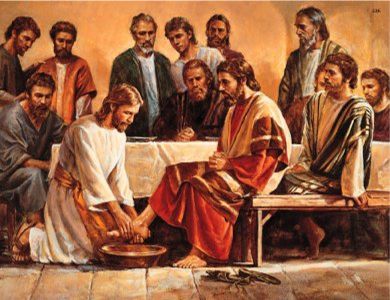
A meditation on Lent from The Liturgical
Year by Abbot Dom Guéranger,
O.S.B.
After having, on this day, washed the feet of His
disciples, Jesus said to them: 'Know ye what I have done to you? You call Me
Master and Lord: and You say well, for so I am. If then I, being your Lord and
Master, have washed your feet; you, also, ought to wash one another's feet. For
I have given you an example, that as I have done to you, so you do also.'[1]
Although the meaning of these words is that, after the example of our divine
Master, we should practice works of fraternal charity towards our neighbour, yet
the literal imitation of this our Saviour's act has always been observed in the
Church.
At the commencement, it was almost a daily practice. St. Paul, when mentioning
the qualities which should adorn the Christian widow, includes that of washing
the feet of the saints,[2] that is, of the faithful. We find this act of humble
charity practised in the ages of persecution, and even later. The Acts of the
saints of the first six centuries, and the homilies and writings of the holy
fathers, are filled with allusions to it. Afterwards, charity grew cold, and
this particular way of
exercising it was confined, almost exclusively, to
monasteries. Still, from time to time it was practiced elsewhere. We
occasionally find kings and queens setting this example of humility. The holy
king Robert of France, and, later, Saint Louis, used frequently to wash the feet
of the poor. The holy queen St. Margaret of Scotland, and Saint Elizabeth of
Hungary, did the same. The Church, with that spirit which makes her treasure up
every recommendation of her divine Lord, has introduced this act of humility
into her liturgy, and it is today that she puts the great lesson before her
children. In every church of any importance, the prelate, or superior, honours
our Saviour's condescension, by the ceremony called the washing of the feet.
The bishops throughout the world follow the example set them by the sovereign
Pontiff, who performs this ceremony in the Vatican. Yea, there are still to be
found kings and queens who, on this day, wash the feet of the poor, and give
them abundant alms.
The twelve apostles are represented by the twelve poor who, according to the
most general practice, are chosen for this ceremony. The Pope, however, washes
the feet of thirteen priests of as many different countries; and this is the
reason of the ceremonial requiring this number for cathedral churches. But, why
thirteen? Some have interpreted it thus: that it represented the full number of
the apostolic college, which is thirteen; for St. Mathias was elected in Judas's
place, and our Lord Himself, after His Ascension, called St. Paul to be an
apostle. Other authors, however, and among them the learned Pope Benedict
XIV,[3] assert that the reason of this number being chosen was the miracle
related in the life of St. Gregory the Great. This holy Pope used, every day, to
wash the feet of twelve poor men, whom he afterwards invited to his own table.
One day, a thirteenth was present: it was an angel, whom God had sent, that He
might thereby testify how dear to Him was the charity of His servant.
The ceremony of the washing of the feet is also called the Mandatum, from
the first word of the first antiphon. After the deacon has chanted the Gospel of
the Mass of Maundy Thursday, the celebrant takes off the cope, girds himself
with a towel, and, kneeling down, begins to wash the feet of those who have been
chosen. He kisses the right foot of each one after having washed it.
ENDNOTES
1. 1 St. John xiii. 12-15.
2 1 Tim. v. 10.
3 De Festis D. N.J. C. lib. I. cap. vi. no. 57
News, articles and other items of interest from a traditional Irish Catholic viewpoint
Wednesday, April 4, 2012
Saturday, March 31, 2012
A Guide to Help an Examination of Conscience Before Confession
Prior to confession, as well as each day in our life, we
should compare our lives with the Ten Commandments. Only through sincere
examination can we identify our faults and know what we must confess and where
we must strive to live more as Christ would have us live.
First - I am the Lord thy God. Thou shalt not have strange gods before me.
* Do I give God time every day in prayer?
* Do I seek to love Him with my whole heart?
* Have I been involved with superstitious practices or have I been involved with the occult?
* Do I seek to surrender myself to God’s Word as taught by the Church?
* Have I ever received Communion in a state of mortal sin?
* Have I ever deliberately told a lie in confession or have I withheld a mortal sin from the priest in confession?
* Have I been guilty of great irreverence in church?
* Excessive talking, immodest dress, talking on the phone, loud calling out.
* Have I kept the one hour Eucharistic Fast?Second - Thou shalt not take the name of the Lord thy God in vain.
* Have I used God’s name in vain: lightly or carelessly?
* Have I been angry with God?
* Have I wished evil upon another person?
* Have I insulted a sacred person or abused a sacred object?Third - Remember to keep holy the Lord’s Day.
* Have I deliberately missed Mass on Sundays or Holy Days of Obligation?
* Have I tried to observe Sunday as a family day and a day of rest?
* Do I do needless work on Sunday?
* Have I made others miss Mass on Sundays or Holy Days of obligation, leave early or be late for Mass?
* Have I been willfully distracted during Mass?
Fourth - Honor thy Father and thy Mother.
* Do I honor and obey my parents?
* Have I neglected my duties to my spouse and children?
* Have I given my family, my children, good religious example and training?
* Do I try to bring peace into my home life?
* Do I care for my aged and infirm parents and relatives?
* Do I respect my parents
* Am I obedient to my parents
Fifth - Thou shall not kill.
* Have I had an abortion or encouraged anyone to have an abortion? Or used pills such as the morning after pill?
* Have I physically harmed anyone?
* Have I abused alcohol or drugs? Driven while under the influence of these?
* Did I give scandal to anyone, thereby leading them into sin?
* Have I been angry or resentful?
* Hove I harbored hatred in my heart?
* Have I mutilated myself through any form of sterilization?
* Have I encouraged or condoned sterilization?
* Have I abused myself through gluttony
* Have I harbored a grudge against anyone
* Have I sought to destroy someone’s reputation
* Have I mutilated my body in any way
Sixth - Thou shalt not commit adultery.
* Have I been faithful to my marriage vows in thought and action?
* Have I treated my wife with respect and dignity?
* Have I directed my husband to do what is right?
* Have I engaged in any sexual activity outside of marriage?
* Have I used any method of contraception or artificial birth control in my marriage?
* Has each sexual act in my marriage been open to the transmission of new life?
* Have I been guilty of masturbation?
* Have I sought to control my thoughts?
* Have I respected all members of the opposite sex, or have I thought of other people as objects?
* Have in engaged in impure conversations or joke telling?
* Have I deliberately looked at indecent images?
* Have I used pornographic or soft pornographic material?
* Have I been guilty of any homosexual activity?
* Do I seek to be chaste in my thoughts, words and actions?
* Am I careful to dress modestly?
Seventh - Thou shalt not steal.
* Have I stolen what is not mine?
* Have I returned or made restitution for what I have stolen?
* Do I waste time at work, school or at home?
* Do I gamble excessively, thereby denying my family of their needs?
* Do I pay my debts promptly?
* Do I seek to share what I have with the poor?
* Have I cheated my employers?
* Have I cheated my employees.
* Do I pay them a fair wage and treat them fairly?
* Have I run my business ethically and charged a fair price?
* Have I made an unfair profit?
* Are my workers and suppliers treated fairly?
* Have I spent money lavishly, or saved an amount more than I’ll ever need while many die of starvation?
Eighth - Thou shalt not bear false witness against thy neighbor.
* Have I lied?
* Have I gossiped?
* Have I spoken behind someone else’s back?
* Am I sincere in my dealings with others?
* Am I critical, negative or uncharitable in my thoughts of others?
* Do I keep secret what should be kept confidential?
Ninth - Thou shalt not covet thy neighbor’s wife.
* Have I consented to impure thoughts?
* Have I caused them by impure reading, movies, conversations or curiosity?
* Do I seek to control my imagination?
* Do I pray at once to banish impure thoughts and temptations?
Tenth - Thou shalt not covet thy neighbor’s goods.
* Am I jealous of what other people have?
* Do I envy the families or possessions of others?
* Am I greedy or selfish?
* Are material possessions the purpose of my life? *Do I spend a majority of my time concerned with wealth accumulation?
* Do I trust that God will care for all of my material and spiritual needs?
The Spiritual and Corporal Works of Mercy
Have I neglected to do the following when circumstances obliged me:
The Seven Spiritual Works of Mercy
1. To admonish sinners.
2. To instruct the ignorant.
3. To counsel the doubtful.
4. To comfort the sorrowful.
5. To bear wrongs patiently.
6. To forgive all injuries.
7. To pray for the living and the dead?
The Seven Corporal Works of Mercy
1. To feed the hungry.
2. To give drink to the thirsty.
3. To clothe the naked.
4. To visit and ransom the captives.
5. To harbor the harborless.
6. To visit the sick.
7. To bury the dead
The Seven Deadly Sins and the Opposite Virtues
1. Pride -- Humility
2. Covetousness -- Liberality
3. Lust-- Chastity
4. Anger -- Meekness
5. Gluttony -- Temperance
6. Envy -- Brotherly love
7. Sloth -- Diligence
Five Effects of Pride
1. Vainglory: a. Boasting b. Dissimulation / Duplicity
2. Ambition
3. Contempt for others
4. Anger! Revenge / Resentment
5. Stubbornness! Obstinacy.
Nine Ways of Being an Accessory to Another’s Sin
a. Have I knowingly caused others to sin?
b. Have I cooperated in the sins of others:
1. By counsel.
2. By command.
3. By consent.
4. By provocation.
5. By praise or flattery.
6. By concealment.
7. By partaking.
8. By silence.
9. By defense of the ill done?
The Four Sins which Cry to Heaven for Vengeance
1. Willful Murder.
2. The sin of Sodomy or Lesbianism.
3. Oppression of the poor.
4. Defrauding the laborer of his just wages.
Friday, March 23, 2012
The carpenter who kept hundreds of fugitive Catholics alive
From http://www.catholicherald.co.uk/spirituallife/saintoftheweek/2012/03/22/the-carpenter-who-kept-hundreds-of-fugitive-catholics-alive/
Nicholas Owen (c 1550-1606) was one of four sons of Walter Owen, a carpenter who lived in Oxford. Inheriting his father’s skill, he came to specialise in the construction of concealed priest-holes in country houses. Many Catholics on the run owed their lives to him.
“I verily think,” noted Fr John Gerard, “that
no one can be said to have done more good of all those who laboured in
the English vineyard.
“He was the immediate occasion of saving many hundreds of persons, both ecclesiastical and secular, which had been lost and forfeited many times over if the priests had been taken in their houses.”
Owen is first encountered in 1581 in connection with the martyrdom of Edmund Campion, whose servant he may have been. At all events, he maintained Campion’s innocence of treason with such force that he himself was imprisoned.
He must have been tough to survive the appalling conditions, which killed one of his fellow prisoners. Yet he was a small man who walked with a pronounced limp after a pack horse fell on top of him and broke his leg.
From 1586 Owen was in the service of Fr Henry Garnet, the Jesuit Provincial, with whom he travelled extensively, staying at Catholic houses where he constructed supremely well-disguised hiding places.
A few authentic examples survive: for example, at Sawston Hall near Cambridge, Huddington Court in Worcestershire and Coughton Court in Warwickshire.
To maintain security Owen would never discuss this work. While constructing a priest-hole he would ostentatiously engage in repairs in some other part of the house during the day, and work on his hiding places at night.
In 1594 Owen accompanied another priest, Fr Gerard, to London, to help him with the purchase of a house. While in town, however, they were betrayed by a servant of the Wiseman family, for whom Owen had constructed a refuge at Broadoaks in Essex.
The authorities, aware that Owen was a repository of many secrets of recusant life, tortured him most horribly, but without extracting any compromising information. After his release he helped Fr Gerard escape from the Tower of London by means of a rope strung across the moat.
The Gunpowder Plot of 1605 again made Owen a wanted man. With three other Jesuits he took refuge at Hindlip Hall in Worcestershire. When the house was raided, 100 men were employed to search for them, but failed to find the priest-hole.
After eight days the starving Owen slipped out of the hiding place unobserved and tried to pass himself off to his captors as a priest in order to save Fr Garnet.
The ruse failed, and Owen was mercilessly tortured in the Tower, until on March 22 1606 his entrails burst out when he was on the rack, and he expired.
“He was the immediate occasion of saving many hundreds of persons, both ecclesiastical and secular, which had been lost and forfeited many times over if the priests had been taken in their houses.”
Owen is first encountered in 1581 in connection with the martyrdom of Edmund Campion, whose servant he may have been. At all events, he maintained Campion’s innocence of treason with such force that he himself was imprisoned.
He must have been tough to survive the appalling conditions, which killed one of his fellow prisoners. Yet he was a small man who walked with a pronounced limp after a pack horse fell on top of him and broke his leg.
From 1586 Owen was in the service of Fr Henry Garnet, the Jesuit Provincial, with whom he travelled extensively, staying at Catholic houses where he constructed supremely well-disguised hiding places.
A few authentic examples survive: for example, at Sawston Hall near Cambridge, Huddington Court in Worcestershire and Coughton Court in Warwickshire.
To maintain security Owen would never discuss this work. While constructing a priest-hole he would ostentatiously engage in repairs in some other part of the house during the day, and work on his hiding places at night.
In 1594 Owen accompanied another priest, Fr Gerard, to London, to help him with the purchase of a house. While in town, however, they were betrayed by a servant of the Wiseman family, for whom Owen had constructed a refuge at Broadoaks in Essex.
The authorities, aware that Owen was a repository of many secrets of recusant life, tortured him most horribly, but without extracting any compromising information. After his release he helped Fr Gerard escape from the Tower of London by means of a rope strung across the moat.
The Gunpowder Plot of 1605 again made Owen a wanted man. With three other Jesuits he took refuge at Hindlip Hall in Worcestershire. When the house was raided, 100 men were employed to search for them, but failed to find the priest-hole.
After eight days the starving Owen slipped out of the hiding place unobserved and tried to pass himself off to his captors as a priest in order to save Fr Garnet.
The ruse failed, and Owen was mercilessly tortured in the Tower, until on March 22 1606 his entrails burst out when he was on the rack, and he expired.
Labels:
Catholic Martyrs,
Christian Persecution,
Saints
Tuesday, March 20, 2012
Vatican urges Church to listen to victims
From http://www.rte.ie/news/2012/0320/abuse.html
The Vatican has published its report on the child abuse crisis in the Catholic Church in Ireland.
It recommends that Irish diocesan authorities and those of religious institutes should continue to devote time to listening to victims and providing support for them and their families.
The findings are based on an apostolic visitation to the four archdioceses, religious congregations and seminaries.
The report found that the current guidelines on child protection were being followed.
It said Archbishops had given assurances that any newly-discovered cases of abuse were brought before the competent civil authority and the congregation for the doctrine of the faith.
The report said that it must be acknowledged that within the Christian community innocent young people were abused by clerics and religious to whose care they had been entrusted, while those who should have exercised vigilance often failed to do so effectively.
It said that in delivering its findings, the Holy See re-echoes the sense of dismay and betrayal that the Pope expressed in his letter to Catholics in Ireland two years ago, "regarding the sinful and criminal acts that were at the root of this particular crisis".
Primate of All Ireland Cardinal Sean Brady welcomed the publication of the findings of the visitation.
Cardinal Brady said the church expressed a heartfelt plea for forgiveness from victims and from God for the terrible sins and crimes of abuse.
He also emphasised that the visitation was pastoral in nature and was intended to assist the Irish church on its path of renewal.
Archbishop of Dublin Diarmuid Martin said the extent of the child abuse crisis was shattering and that the children who had been abused should be foremost in our minds.
Admission criteria for seminaries
The report on the visitation also proposed more consistent admission criteria for seminaries and in-depth formation on child protection for priests as part of their academic programme.
It proposed that seminary buildings should be exclusively for seminarians and those preparing them for the priesthood.
On the religious congregations, the report found that all religious institutes should perform an audit of their personnel files, if such an audit has not yet been carried out.
Commenting on the findings, Sr Marianne O'Connor of CORI, acknowledged that there had been a slowness to understand the impact of child abuse.
Sr O'Connor insisted that the religious orders and the church were heartfelt in their apology for the abuse crisis.
She said there was a focus on ensuring child safety procedures were in place, and on the ongoing support of victims.
Pope Benedict promised report
The report was promised two years ago by Pope Benedict XVI in his letter to Catholics in Ireland.
The Pope expressed horror and dismay in the wake of the Ryan and Murphy reports, which revealed a 70-year history child abuse by a significant number of priests, brothers and nuns and cover-ups by their religious superiors.
The Pope assigned six teams to formally assess the implications of the abuse scandals in each of the country's four archdioceses, in religious orders and congregations based in Ireland and abroad.
Some of the teams met victims and concerned Catholics in advertised locations, as well as individual survivors behind closed doors.
Minister for Transport Leo Varadkar has said the Government's priority is to protect children and to put legislation in place to make sure that is the case.
Mr Varadkar said legislation to put the Children First regulations on a statutory footing would go to committee before Easter, while a standalone referendum on children's rights would be held before the end of the year.
The Vatican has published its report on the child abuse crisis in the Catholic Church in Ireland.
It recommends that Irish diocesan authorities and those of religious institutes should continue to devote time to listening to victims and providing support for them and their families.
The findings are based on an apostolic visitation to the four archdioceses, religious congregations and seminaries.
The report found that the current guidelines on child protection were being followed.
It said Archbishops had given assurances that any newly-discovered cases of abuse were brought before the competent civil authority and the congregation for the doctrine of the faith.
The report said that it must be acknowledged that within the Christian community innocent young people were abused by clerics and religious to whose care they had been entrusted, while those who should have exercised vigilance often failed to do so effectively.
It said that in delivering its findings, the Holy See re-echoes the sense of dismay and betrayal that the Pope expressed in his letter to Catholics in Ireland two years ago, "regarding the sinful and criminal acts that were at the root of this particular crisis".
Primate of All Ireland Cardinal Sean Brady welcomed the publication of the findings of the visitation.
Cardinal Brady said the church expressed a heartfelt plea for forgiveness from victims and from God for the terrible sins and crimes of abuse.
He also emphasised that the visitation was pastoral in nature and was intended to assist the Irish church on its path of renewal.
Archbishop of Dublin Diarmuid Martin said the extent of the child abuse crisis was shattering and that the children who had been abused should be foremost in our minds.
Admission criteria for seminaries
The report on the visitation also proposed more consistent admission criteria for seminaries and in-depth formation on child protection for priests as part of their academic programme.
It proposed that seminary buildings should be exclusively for seminarians and those preparing them for the priesthood.
On the religious congregations, the report found that all religious institutes should perform an audit of their personnel files, if such an audit has not yet been carried out.
Commenting on the findings, Sr Marianne O'Connor of CORI, acknowledged that there had been a slowness to understand the impact of child abuse.
Sr O'Connor insisted that the religious orders and the church were heartfelt in their apology for the abuse crisis.
She said there was a focus on ensuring child safety procedures were in place, and on the ongoing support of victims.
Pope Benedict promised report
The report was promised two years ago by Pope Benedict XVI in his letter to Catholics in Ireland.
The Pope expressed horror and dismay in the wake of the Ryan and Murphy reports, which revealed a 70-year history child abuse by a significant number of priests, brothers and nuns and cover-ups by their religious superiors.
The Pope assigned six teams to formally assess the implications of the abuse scandals in each of the country's four archdioceses, in religious orders and congregations based in Ireland and abroad.
Some of the teams met victims and concerned Catholics in advertised locations, as well as individual survivors behind closed doors.
Minister for Transport Leo Varadkar has said the Government's priority is to protect children and to put legislation in place to make sure that is the case.
Mr Varadkar said legislation to put the Children First regulations on a statutory footing would go to committee before Easter, while a standalone referendum on children's rights would be held before the end of the year.
Sunday, March 18, 2012
Sunday, March 11, 2012
Lenten Prayer Before the Crucifix
A plenary indulgence is offered
on Fridays in Lent for the Christian faithful who piously
pray the below prayer in front of a Crucifix, after Communion:
BEHOLD, O good and sweetest Jesus,The usual conditions for the granting of a plenary indulgence apply:
I cast myself upon my knees in Thy sight,
and with the most fervent desire of my soul
I pray and beseech Thee
to impress upon my heart
lively sentiments of faith,
hope and charity,
with true repentance for my sins
and a most firm desire of amendment:
whilst with deep affection and grief of soul
I consider within myself
and mentally contemplate Thy five most precious Wounds,
having before mine eyes that which David, the prophet,
long ago spoke in Thine own person concerning Thee,
my Jesus: “They have pierced My hands and My feet,
they have numbered all My bones.”
N20. §1. To gain a plenary indulgence, in addition to excluding all attachment to sin, even venial sin, it is necessary to perform the indulgenced work and fulfill the following three conditions:
Sacramental confession, Eucharistic Communion, and prayer for the intention of the Sovereign Pontiff.
§2. A single sacramental confession suffices for gaining several plenary indulgences; but Holy Communion must be received and prayer for the intention of the Holy Father must be recited for the gaining of each plenary indulgence.
§ 3. The three conditions may be fulfilled several days before or after the performance of the prescribed work; it is, however, fitting that Communion be received and the prayer for the intention of the Holy Father be said on the same day the work is performed.
§4. If the full disposition is lacking, or if the work and the three prescribed conditions are not fulfilled, saving the provisions given in Norm 24 and in Norm 25 regarding those who are “impeded,” the indulgence will only be partial.
§5. The condition of praying for the intention of the Holy Father is fully satisfied by reciting one Our Father and one Hail Mary; nevertheless, one has the option of reciting any other prayer according to individual piety and devotion, if recited for this intention.
NY Times ad accused of 'hate speech' against Catholics
New York City, N.Y., Mar 9, 2012 (CNA).
A secularist group's New York Times ad that urges Catholics to leave the Church over its' resistance to the contraception mandate is being called “hate speech” by critics.
“Not a single Catholic who reads this ad will be impelled to leave the Church. That is not the issue,” said Catholic League president Bill Donohue. “The issue is the increase in hate speech directed at Catholics.”
The Madison, Wisconsin-based Freedom from Religion Foundation ad “It’s Time to Quit the Catholic Church” ran on March 9 and billed itself as an “open letter to 'liberal' and 'nominal' Catholics.”
“Will it be reproductive freedom, or back to the Dark Ages?” it asks. “Do you choose women and their rights, or Bishops and their wrongs? Whose side are you on?”
The ad claims that the church is “an avowedly antidemocratic Old Boys club” and derides Catholic teaching that contraception use is sinful. It also blames the Church for causing misery, poverty, unwanted pregnancies and deaths and attacks Catholic teaching on the ordination of women, parochial schools, and the Church’s response to sex abuse.
The ad, which includes an unflattering political cartoon of a Catholic bishop, claims that the U.S. Catholic bishops' conference has made a “declaration of war against women's right to contraception.”
U.S. Catholics are presently in a battle with the Obama administration over new federal mandates requiring employers, including religious employers, to provide insurance coverage for sterilization and contraception, including some abortion-causing drugs.
The secularist group’s ad claimed that these Catholic efforts are an attempt “to use the force of secular law to deny birth control to non-Catholics” and claimed that the Church’s effort to defend non-mandatory coverage is a “ruthless political inquisition.”
The foundation’s website says it raised $52,000 to place the ad on page 10 of the Times’ front section.
Donohue harshly criticized the newspaper ad, saying it engages in a “palpable” demonization of the Catholic Church and uses the HHS mandate as a “pretext” to attack the Church.
“Nothing will stop Catholics from demanding that the Obama administration respect their First Amendment rights, this vile assault by (the foundation) notwithstanding,” he said. “Why the Times allowed this ad is another issue altogether.”
A secularist group's New York Times ad that urges Catholics to leave the Church over its' resistance to the contraception mandate is being called “hate speech” by critics.
“Not a single Catholic who reads this ad will be impelled to leave the Church. That is not the issue,” said Catholic League president Bill Donohue. “The issue is the increase in hate speech directed at Catholics.”
The Madison, Wisconsin-based Freedom from Religion Foundation ad “It’s Time to Quit the Catholic Church” ran on March 9 and billed itself as an “open letter to 'liberal' and 'nominal' Catholics.”
“Will it be reproductive freedom, or back to the Dark Ages?” it asks. “Do you choose women and their rights, or Bishops and their wrongs? Whose side are you on?”
The ad claims that the church is “an avowedly antidemocratic Old Boys club” and derides Catholic teaching that contraception use is sinful. It also blames the Church for causing misery, poverty, unwanted pregnancies and deaths and attacks Catholic teaching on the ordination of women, parochial schools, and the Church’s response to sex abuse.
The ad, which includes an unflattering political cartoon of a Catholic bishop, claims that the U.S. Catholic bishops' conference has made a “declaration of war against women's right to contraception.”
U.S. Catholics are presently in a battle with the Obama administration over new federal mandates requiring employers, including religious employers, to provide insurance coverage for sterilization and contraception, including some abortion-causing drugs.
The secularist group’s ad claimed that these Catholic efforts are an attempt “to use the force of secular law to deny birth control to non-Catholics” and claimed that the Church’s effort to defend non-mandatory coverage is a “ruthless political inquisition.”
The foundation’s website says it raised $52,000 to place the ad on page 10 of the Times’ front section.
Donohue harshly criticized the newspaper ad, saying it engages in a “palpable” demonization of the Catholic Church and uses the HHS mandate as a “pretext” to attack the Church.
“Nothing will stop Catholics from demanding that the Obama administration respect their First Amendment rights, this vile assault by (the foundation) notwithstanding,” he said. “Why the Times allowed this ad is another issue altogether.”
Drug, Food, Cosmetic Companies are Using Aborted Baby Cells, Says Scientist
LifeSiteNews.com March 5, 2012
While Pepsi has been in the spotlight lately for contracting with a company that uses cells originally derived from an aborted fetus in flavor research, it’s not the only company that pro-lifers should think about boycotting for such unethical practices, reports the National Catholic Register.
Rebecca Taylor, a Technologist in Molecular Biology, has compiled a list of companies that use cells and tissues derived from aborted babies to develop their products, which range from childhood vaccines to cosmetics. Her list includes one English company, ReNeuron, which has applied for clinical trials in the United States.
Here are the companies, with their contact information. To find out more about how these companies use cells derived from aborted fetuses, read the piece below.
Neuralstem
9700 Great Seneca Highway
Rockville, MD 20850
Phone: 301.366.4960
ReNeuron,
10 Nugent Rd
Surrey Research Park
Guildford, Surrey
GU2 7AF
UK
Email: info@reneuron.com
Neocutis Inc.
3053 Fillmore Street # 140
San Francisco CA 94123
Phone: 1-866-636-2884
Email: info@neocutis.com
Merck
One Merck Drive
P.O. Box 100
Whitehouse Station, NJ 08889-0100 USA
Phone: 908-423-1000
GlaxoSmithKline
GlaxoSmithKline plc
One Franklin Plaza
PO Box 7929
Philadelphia PA 19101
Phone: 1-888-825-5249
Senomyx, Inc.
4767 Nexus Centre Drive
San Diego, California 92121
Phone: (858) 646-8300
Email: info@senomyx.com
Taylor notes that Senomyx, which tests flavor enhancers using a cell line derived from the kidney tissue of an aborted baby has reportedly contracted with PepsiCo, Kraft and Nestle.
Subscribe to:
Posts (Atom)
